What is deep search, and how does it differ from deep research?

Deep search is a search process that goes beyond a single query and its top results, running additional searches or exploring sources more thoroughly to answer a difficult question. Unlike ordinary search, it can spend more time and compute finding information that would otherwise be easy to miss.
We work on both sides of this distinction at Exa. Exa Deep is a search mode built for harder queries where finding the right results requires more work, while Exa Agent goes further by searching, reading, and synthesizing information across multiple steps. In practice, that distinction maps closely to what people increasingly mean by deep search versus deep research.
This guide explains what deep search means in AI, how it differs from deep research, how Exa approaches both, and where the other uses of the term fit.
What is deep search?
Deep search trades speed for coverage. In AI research, it is a retrieval mode in which a model treats a question as a small research project. While a standard search sends one query and returns a list of links, a deep search breaks the question into several queries, reads the resulting pages, identifies unanswered points, and searches again before responding.
After completing that process, the system returns an answer or structured result with citations linking each claim to its supporting page. Consumer products often present this result as a report. ChatGPT's deep research can take 5 to 30 minutes, while Google says a Gemini Deep Research report usually takes about 5 to 10 minutes.
That extra work makes deep search useful when an answer is spread across many pages, buried beyond the top results, or needs confirmation from another source. When one page provides an obvious answer, standard search remains faster and cheaper.
How deep search works
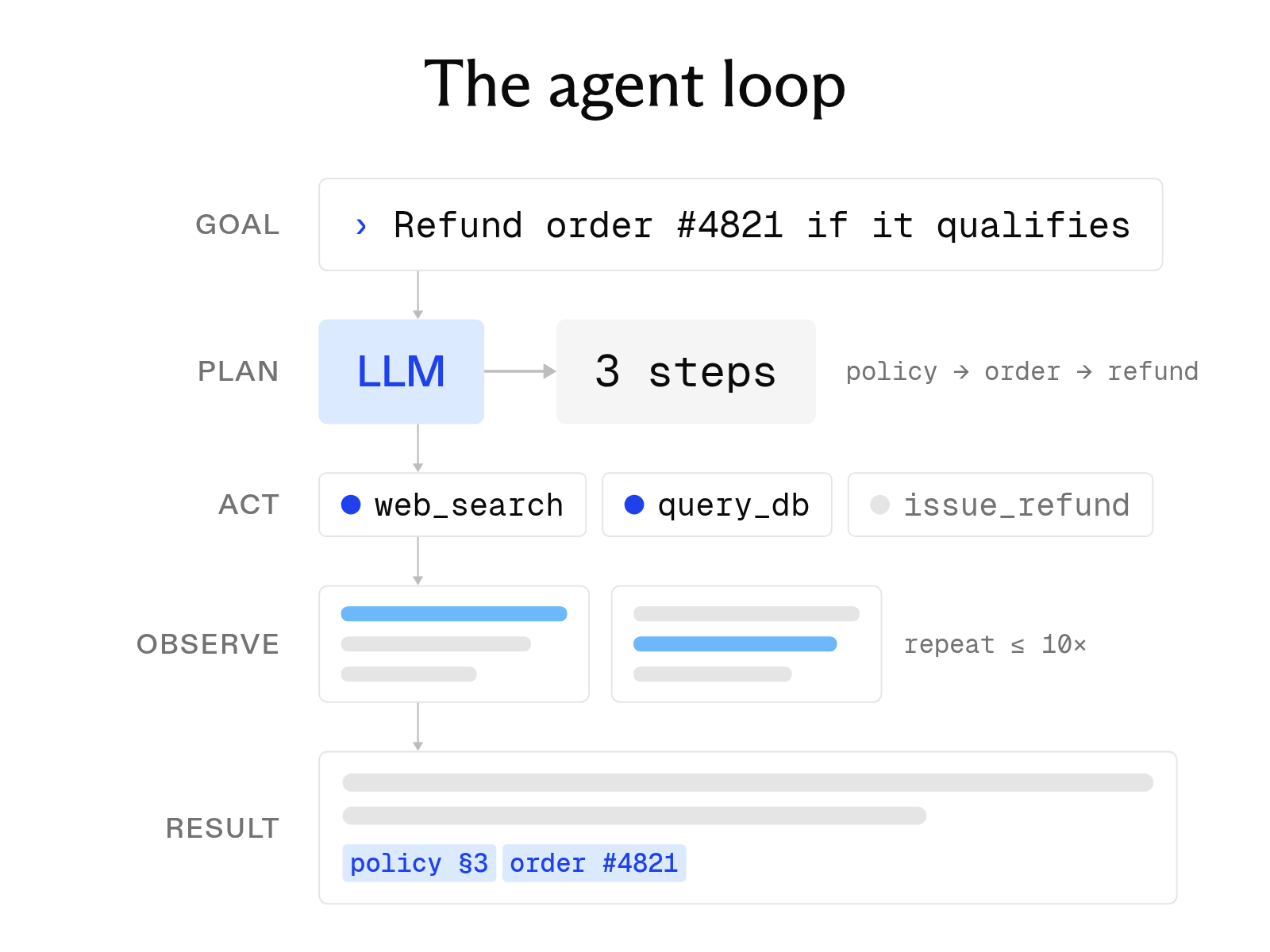
Most AI deep search systems follow a repeating cycle of planning, browsing, and synthesis.
-
Agent planning. A model reads the question and divides it into smaller questions. For example, “Which open-source vector databases support hybrid search, and how are they licensed?” becomes a list of databases, plus separate searches for each database’s hybrid search support and license.
-
Iterative browsing. The agent runs each query, reads the results, and compares the findings with the original question. If a question remains open or two sources conflict, the agent writes a narrower query and searches again. It stops when the evidence is complete or when it reaches a limit on time, steps, or cost.
-
Synthesis. The model writes an answer from the evidence it collected and adds a citation to each claim. Some systems produce a written report. Others fill a structured format, such as a table with one row per database, and cite each field.
Deep search applications
The additional time pays off when the system must assemble an answer from multiple sources rather than retrieve it through a single query.
-
Market and competitor research. Compile pricing, launches, and positioning for a set of competitors from their own sites and from recent coverage.
-
Due diligence. Check a company's funding, leadership, legal history, and press mentions, with a source attached to each finding.
-
Literature and technical review. Gather papers, documentation, or standards on a narrow topic and summarize them by approach.
-
Codebase questions. Ask how a feature works across a large repository. Sourcegraph Deep Search runs an agentic loop over your code and lists the files it used as sources.
In each case, deep search handles the manual work of opening multiple browser tabs, reading each source, and comparing the findings. How much of this work the system handles helps distinguish deep search from deep research.
How deep search differs from deep research
The terms overlap, and no standard separates them clearly. Still, the scope of the task and the share of the research process that the system handles provide a useful distinction.
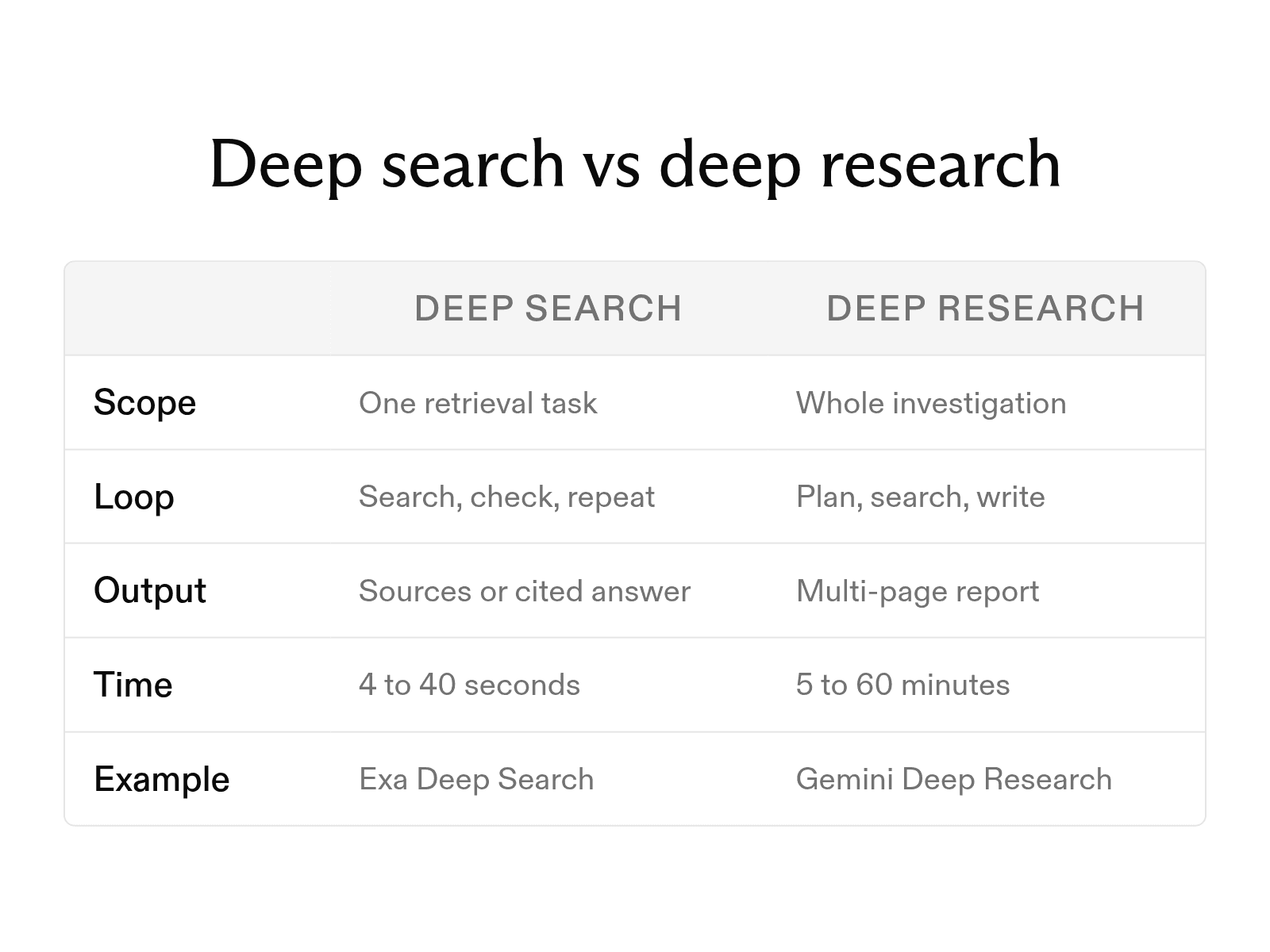
Deep search focuses on a single retrieval task. It expands the query, runs follow-up searches, checks the evidence, and returns either a set of sources or a short cited answer. Because it usually operates within a larger application, it is fast enough for someone to wait for the result. For example, Exa’s deep search returns results in about 4 to 40 seconds, depending on the mode.
By contrast, a deep research agent manages a broader investigation and produces a report. It plans the work, runs many searches, decides when each section is complete, and writes the final document. This process takes minutes rather than seconds. Google caps Gemini Deep Research in the API at 60 minutes, while OpenAI says its deep research models can take tens of minutes.
The boundary is not absolute. A deep search with a defined output format can produce a small, structured report, while a deep research agent may rely on repeated deep searches. The meaning shifts further outside AI, where IBM Deep Search, people-search apps, and code-search tools use the term for a thorough search of one type of data without a research agent.
Four types of deep search tools
These differences become clearer when the tools are grouped by what they search and what they return. The table compares the four main types of tools that use the term “deep search,” with one example of each.
| Type | What it searches | Example | What you get |
|---|---|---|---|
| AI research agents | The public web, plus files or connected apps | Gemini Deep Research | A multi-page report with citations, built from up to hundreds of websites |
| Document and code search | Your own documents or repositories | Sourcegraph Deep Search | An answer to a natural-language question about your codebase, with a list of sources |
| People search | Public records and web profiles | Deepsearch AI Search Assistant | Publicly available information about a named person |
| Configurable-depth search API | The web, through a developer endpoint | Exa Deep Search | Ranked results with highlights, or a cited structured answer, at a depth you choose |
The first three are complete products that people use in an app or browser. The fourth is a building block for other products. Developers call it from their code and choose how much depth each request requires, making deep search available through an API.
Using deep search through an API
A deep search API exposes this research loop through a single request. A developer sends a question, selects the search depth, and receives sources and an answer that the application can use.
Exa Deep Search is a mode of the Exa Search API that lets developers set the depth, speed, and freshness of each request. The type parameter controls depth: deep-lite provides lightweight synthesis in about 4 seconds, deep completes multi-step research in 4 to 15 seconds, and deep-reasoning handles harder tasks in 12 to 40 seconds. Developers can use additional_queries to supply up to ten extra search directions and max_age_hours within contents to control how recent the page content must be.
from exa_py import Exa

exa = Exa()
result = exa.search(
    "Which open-source vector databases support hybrid search, and under what license?",
    type="deep",
    additional_queries=["hybrid keyword vector search open source database license"],
    contents={"highlights": True, "max_age_hours": 72},
    output_schema={"type": "text", "description": "A short comparison with citations"},
)
print(result.output.content)
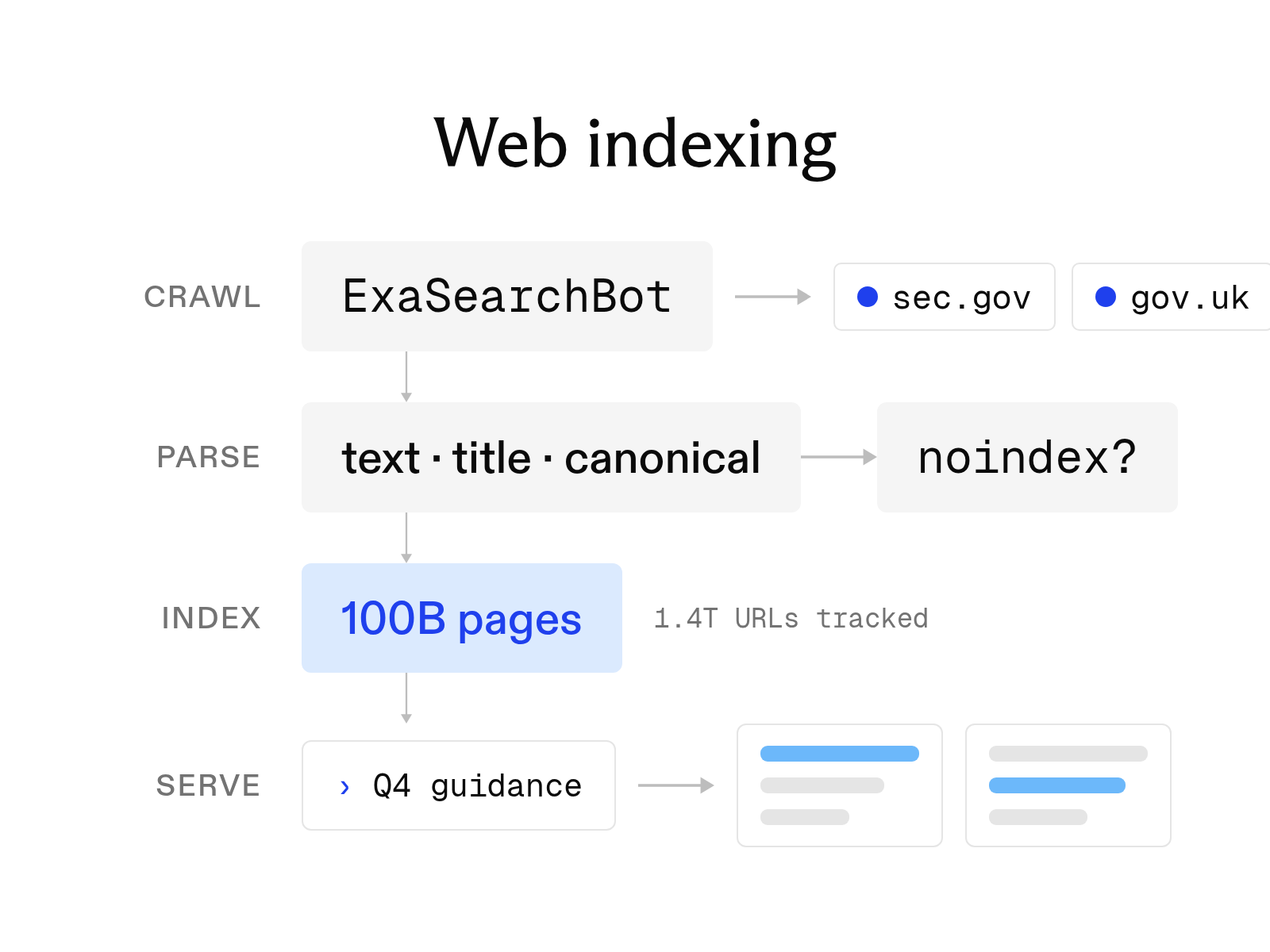
Each response includes search results with highlights from the source pages and an output object whose grounding field lists the answer’s citations. Exa runs these searches across its own index, which tracked 1.4 trillion URLs and served 100 billion pages as of August 2026, giving complex queries a broad pool of pages to search. Deep search costs $12 to $15 per 1,000 requests, depending on the mode.
Other tools called deep search
The name “deep search” also appears in several products with narrower purposes than a general-purpose web research agent.
-
Deepsearch AI Search Assistant is a people-finder app that searches publicly available information about a person using their name. Android and iOS versions are available from different developers.
-
Jina DeepSearch is a developer API designed to “search, read and reason until best answer found.” Its endpoint follows OpenAI’s Chat Completions format, and its code is available as the open-source node-DeepResearch project.
-
IBM Deep Search converts PDF collections into structured JSON and builds searchable knowledge graphs over them, aimed at patents and research papers rather than the open web. IBM's related work on document processing now runs through Docling, its open-source package.
FAQ
Is deep search the same as deep research?
The terms are similar, and many products use them interchangeably. In general, deep search refers to one retrieval process that runs several searches and returns sources or a short cited answer within seconds. Deep research refers to an agent that works for several minutes and produces a full report, often with dozens of citations.
Is Gemini Deep Research free?
Google offers Deep Research to users without a Google AI plan and provides higher limits for Google AI Pro and Ultra subscribers. Google also says the feature may be unavailable to free users during periods of high demand because it requires more computing power.
How long does a deep search take?
The time depends on the tool. Exa’s deep search modes return results in about 4 to 40 seconds. ChatGPT deep research can take 5 to 30 minutes.
Can I use deep search in my own application?
Yes. Exa Deep Search uses the same /search endpoint as standard search, with type set to deep-lite, deep, or deep-reasoning. For longer investigations that return reports, the Gemini API and OpenAI API provide deep research agents. Jina DeepSearch also offers an endpoint compatible with the OpenAI format.
Cheers,
Keep learning
Browse all Learn articles →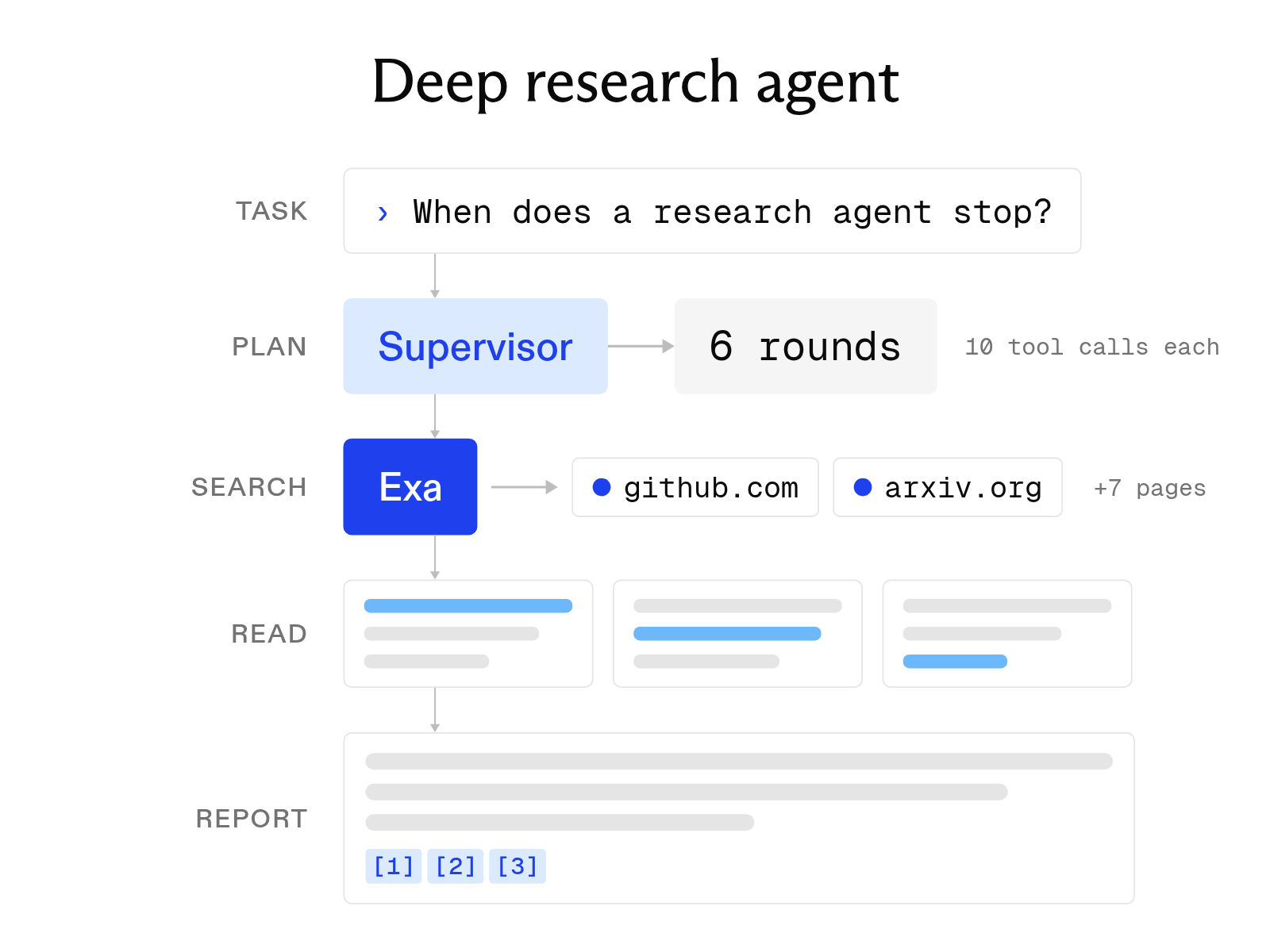
Open-source deep research agents: how they work and how to use them
October 1, 2026
What is web indexing? How it works and why AI search needs its own index
October 6, 2026
What is an AI agent? How it works, key components, and examples
October 1, 2026
How to build an AI agent with web search
October 6, 2026
The 8 best AI search APIs in 2026
October 1, 2026
What a web scraping API is and how to choose one
October 6, 2026