Dynamic Highlights

Let's say your agent wants to know the current mayor of SF. The answer can be found in 9 tokens on a webpage from August 26th, but most agent search tools will pull 10,000+ tokens across many pages, bloating context windows and increasing LLM spend.
Today, we're excited to release a research preview of Dynamic Highlights: given a search query and set of URLs, a custom model dynamically selects just the right tokens across all of the content, reducing token count by an average of 95%, compared to full content of pages.
The Advent of Agent Search
Today, by volume, agents are the primary users of the web.
Agentic context consumption comes with tradeoffs - causing context rot, exhaustion of context windows and unreasonably high LLM costs. This is precisely why token efficiency has never been more critical to search and to Exa's mission.
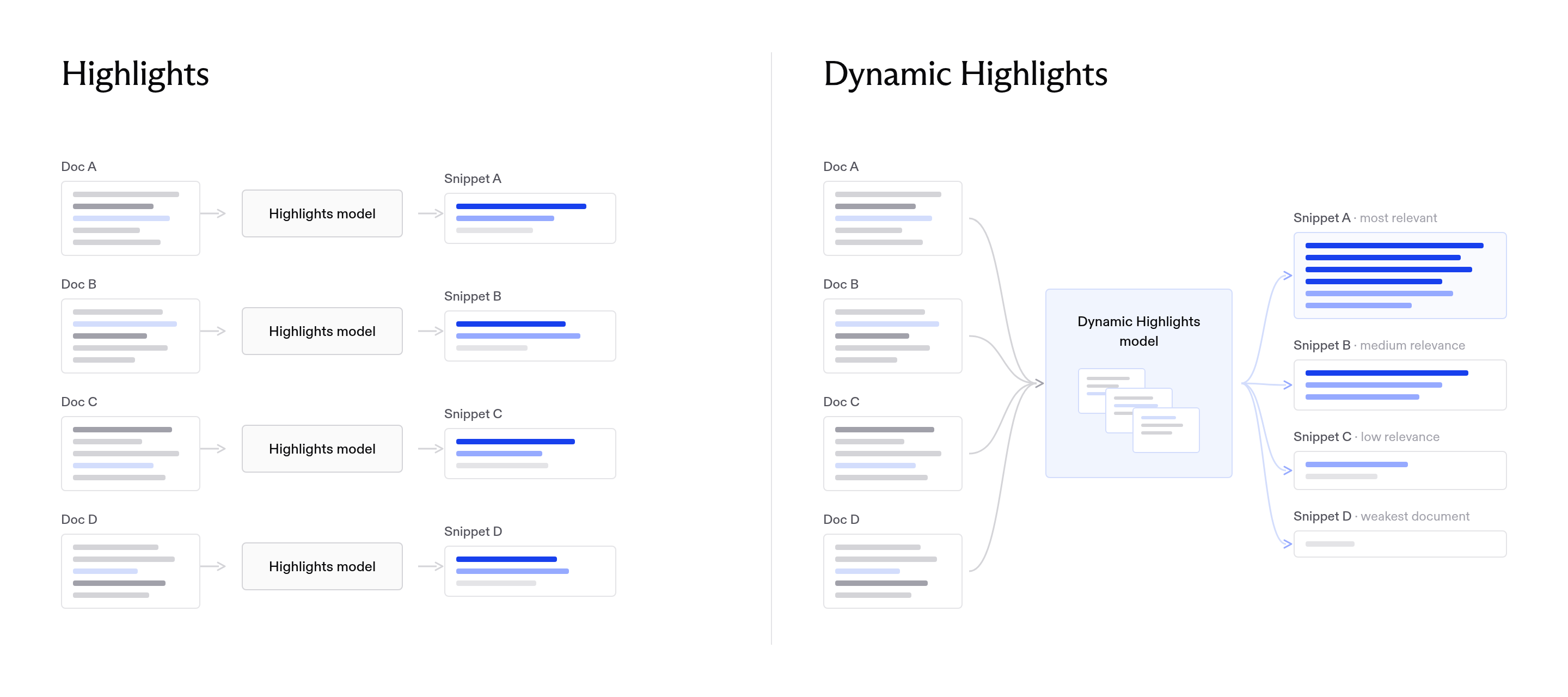
To mitigate this issue, Exa highlights returned snippets of documents in which we returned spans of each document that were relevant to the agent dispatched query. While using standard highlights reduced search tokens by a factor of five, this still led to duplicate information: multiple URLs pulling the relevant tokens that answer a given query or not pulling enough information from highly relevant documents because of per document token budget constraints.
Dynamic Highlights
To solve these problems with highlights, we introduce Dynamic Highlights, a new kind of search primitive that views tokens, not documents, as the fundamental unit of information to retrieve. More explicitly, instead of extracting query-relevant tokens from each document independently, Dynamic Highlights chooses relevant tokens with awareness of all other returned documents.
Dynamic Highlights uses one forward pass rather than many parallel ones, concatenating all retrieved documents into a single unified document. This lets it dynamically allocate more tokens to better content and fewer (or none) to irrelevant documents.
Evals
Single Turn
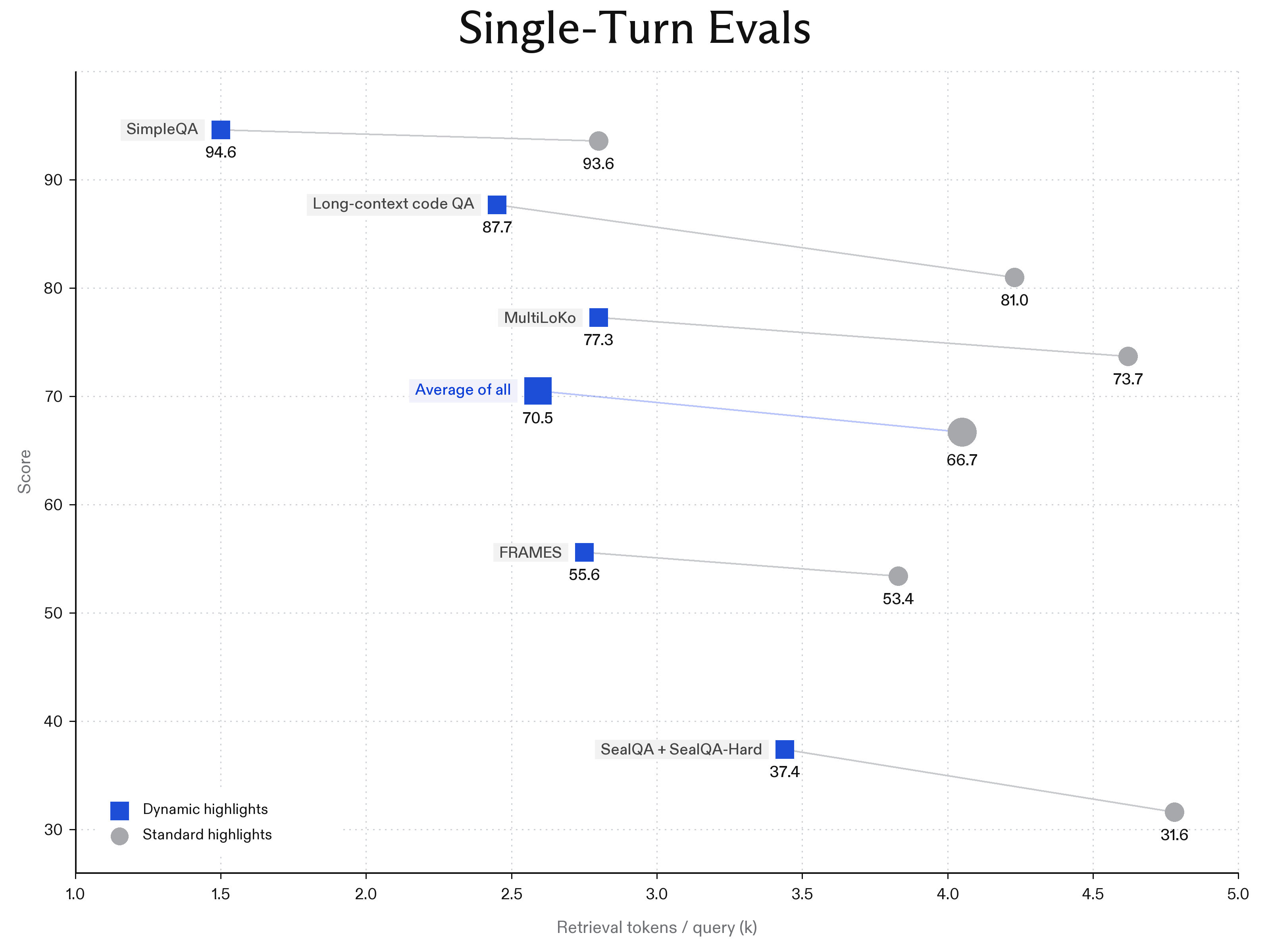
For simple RAG where one search is allowed, we can dramatically reduce the number of tokens returned by search while increasing downstream eval performance.
The results below are from tasks spanning coding to general question-and-answer, averaged across four runs of exa auto with different character limits for dynamic highlights.
With a 12k character budget, relative to existing highlights dynamic highlights achieves a 40% average token efficiency gain with a notable quality increase of 3.8%
Agentic
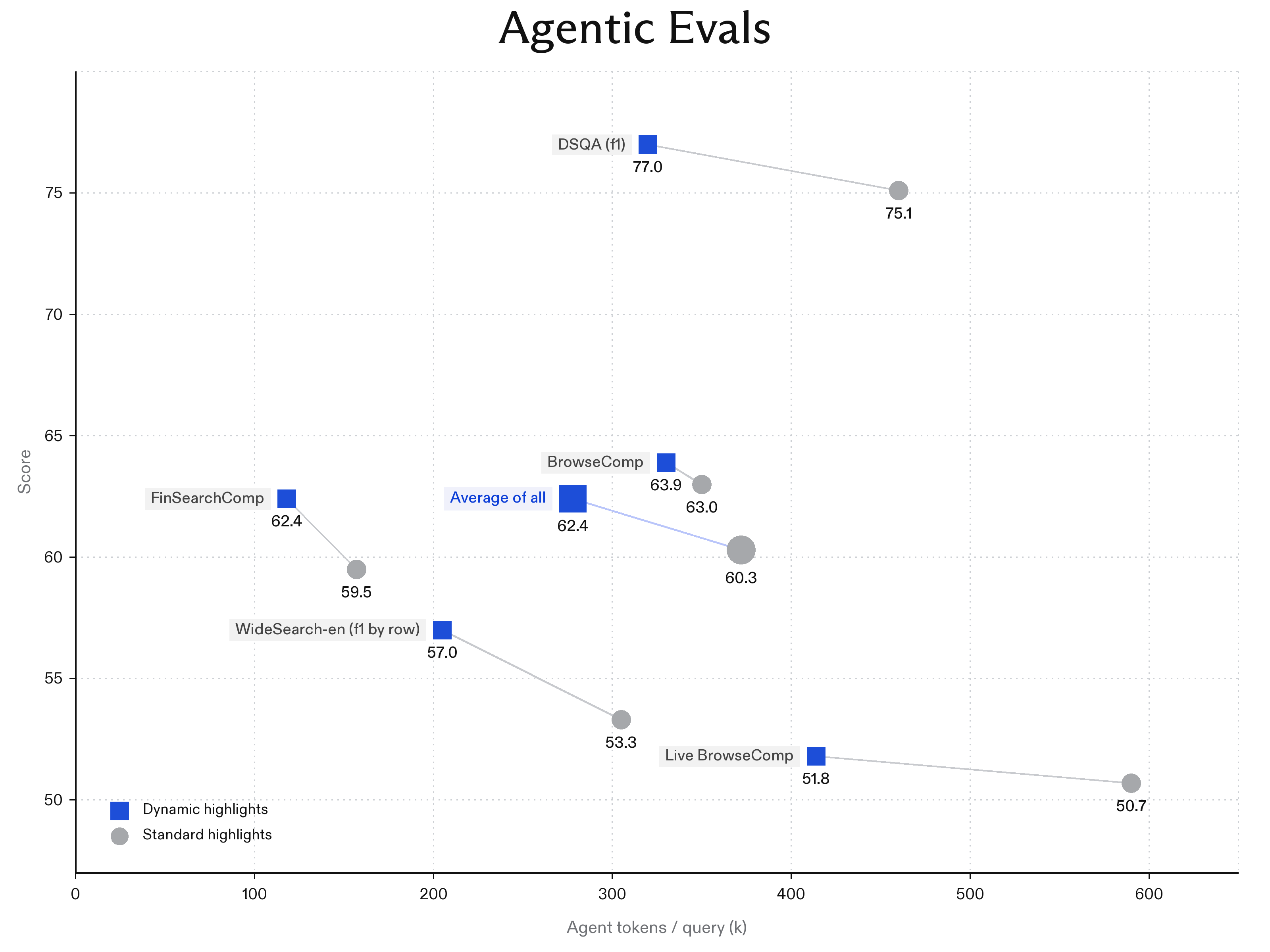
Unlike single-turn search, agents run for longer when they don't find the answers that they are looking for.
Search results are a significant contributor to token budget in such cases. However, reasoning traces take up more than half of the token usage of the agentic searcher, depending on the difficulty of the task.
Therefore, every search token usage optimization must maintain a strict quality bar; otherwise, the increase in the number of searches will eat away at any token efficiency gains.
We use Exa Agent, effort Auto on BrowseComp and WideSearch, as well as Exa Agent, effort Medium for our internal company and people datasets. Although token efficiency varies significantly across different tasks, we can achieve a 30% reduction in agent token usage with a small quality gain (2.1% on average).
This 30% reduction directly translates into cost savings for our users and any search agent products built on top of our API.
How to use it
You can use dynamic highlights by setting dynamic to true in our API — see the docs. As a reminder, this is still a research preview with ongoing development but is our most advanced snippets solution.
{
  "query": "Super Bowl TV ratings 2001 2025 Nielsen household rating viewers table 40.4 127.7 million",
  "type": "auto",
  "numResults": 10,
  "contents": {
    "highlights": {
      "dynamic": true
    }
  }
}