The best You.com API alternatives & competitors, compared
Updated
You.com's Web Search API returns up to one hundred results per call at $5 per 1,000, and comes with $100 in signup credit, SOC 2 compliance, and zero data retention. Teams still look at alternatives for three reasons: the company has shifted its focus to enterprise agent infrastructure, the search call omits page text, and retrieving content requires additional API calls.
Those evaluations tend to weigh payload shape, cost per useful result, and compliance paperwork. This guide compares six web retrieval and answer APIs on features, benchmark results, and where each one fits.
Exa: Web search, research, and retrieval APIs for AI agents
- Founded
- 2021
- Similar to
- Tavily, Brave Search API
- Typical users
- Developers creating software agents and data retrieval systems
- Typical customers
- Early-stage AI companies and software development platforms
What is Exa?
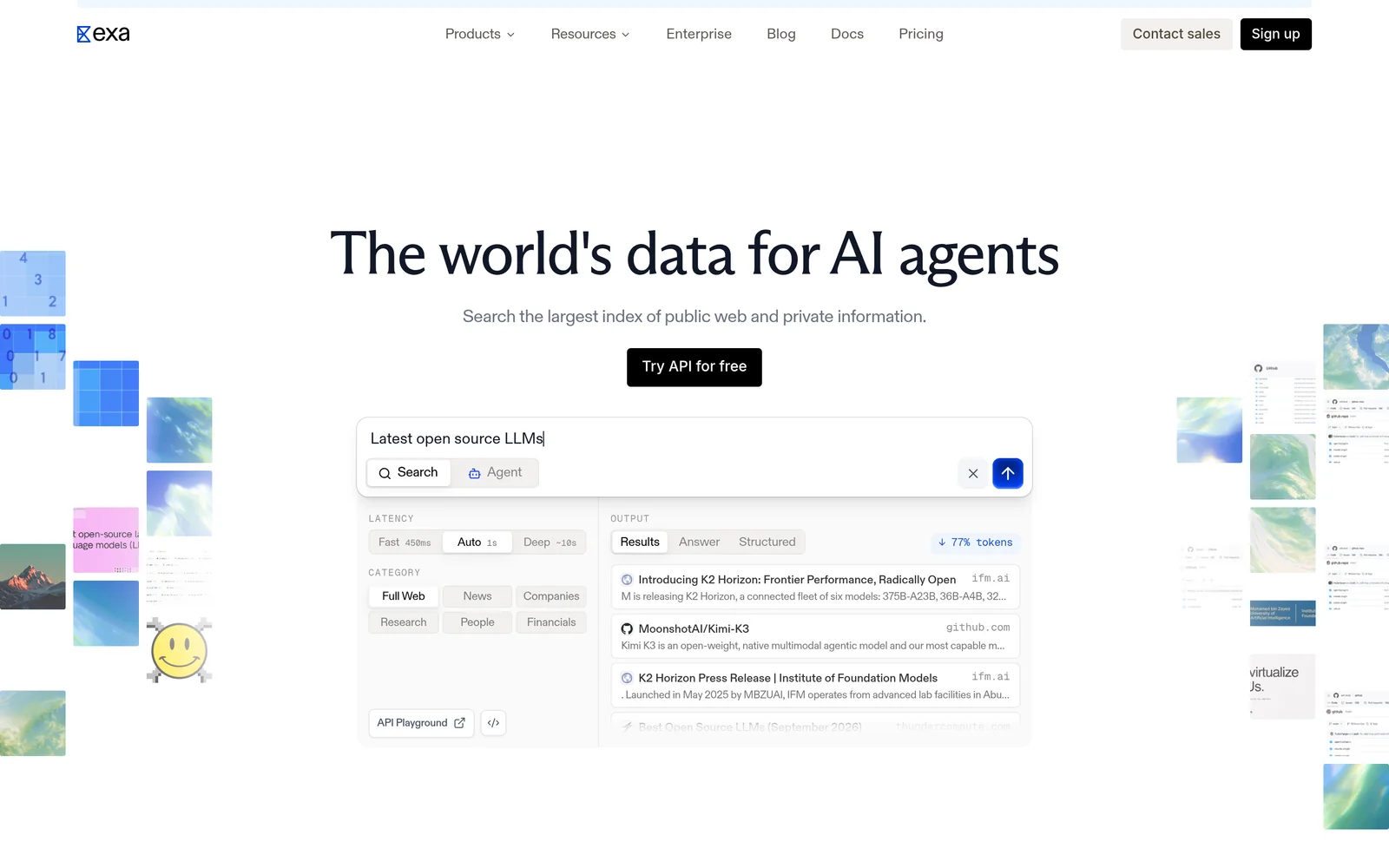
Exa is a search engine built for software rather than people. Given a query, it searches its own neural index and returns ranked results with extracted page text and highlights. Because the search is semantic, a prompt like "early-stage European startups developing humanoid robotics" works as written.
Beyond search, Exa offers Contents for extracting text from URLs you already have, Answer for a cited response in one call, Deep Search for multi-step research, and Monitors for tracking new content on a topic.
Key features
- Search by meaning. Neural search over its own index. Auto, the default search type, picks the best method for each query.
- Page content included in responses. Search starts at $4 per 1,000 requests (Lite); Auto is $7. Both include extracted text and highlights for up to ten results. Most alternatives return links and bill separately for content.
- Category-specific search. Filters for companies, people, and publications, with structured metadata.
- Answer and Deep Search. Cited answers cost $5 per 1,000 requests. Multi-step research runs cost $12 per 1,000.
- Contents and Monitors. Extracting text from URLs you already have costs $1 per 1,000 pages. Scheduled searches that watch a topic cost $15 per 1,000.
- Published rate limits. 10 queries per second on Search, 100 on Contents, and 10 on Answer.
Comparison with You.com
Exa and You.com have the same shape: search, content extraction, and answer endpoints at similar prices. They differ in what the search call returns. You.com returns up to a hundred raw links; Exa returns ten semantically ranked results with text and highlights. Pick based on whether you need link volume or the documents themselves, and whether your queries are keyword strings or natural language.
| Feature | Exa | You.com API |
|---|---|---|
Self-service access Direct setup without contacting sales | Yes | Yes |
Free usage tier Included usage before paid plans | Yes | Yes |
Search cost Price per 1,000 requests | From $4, content included | $5 per 1,000 calls |
Full text in results Extracted content returned in response | Yes | No |
Proprietary web index Independent crawl rather than a third-party wrapper | Yes | Not applicable |
Semantic search Meaning-based retrieval instead of strict keywords | Yes | Not applicable |
Single-call cited answer Combined data retrieval and answer synthesis | Yes | Yes |
Schema-defined output JSON output formatted to custom specifications | Yes | No |
URL content extraction Parses text directly from user-provided URLs | Yes | Yes |
Published rate limits Publicly documented query throughput limits | 10 QPS on Search, custom Enterprise limits | Not applicable |
- Free usage tier: Exa provides $10 a month plus a $10 onboarding bonus, plus free access through Exa MCP with no API key required; You.com API provides $100 in credit.
- Full text in results: Exa includes text and highlights; You.com API bills Contents separately.
- Single-call cited answer: Exa offers Answer at $5 per 1,000 requests; You.com API offers Answer endpoint.
- Schema-defined output: Exa via outputSchema on Answer and JSON-schema summaries on Contents.
- URL content extraction: Exa offers Contents at $1 per 1,000 pages; You.com API offers Contents at $1 per 1,000 pages.
Key technical differences between Exa and You.com
- Exa's Search call includes text and highlights for up to ten results. You.com returns up to a hundred links and bills Contents separately.
- Exa searches its own index by meaning. You.com's pricing page says nothing about its index or how it matches.
- Exa starts at $4 per 1,000 requests, with content included; You.com charges $5 per 1,000 calls.
- Exa publishes a 10 queries per second limit on Search and measured a 472-millisecond median. You.com publishes neither.
Key similarities between Exa and You.com
- Both sell Search, Contents at $1 per 1,000 pages, and an Answer endpoint at $5 per 1,000.
- Both bill per request, with no seat pricing.
- Both give free credit: $10 a month plus a $10 onboarding bonus for Exa, $100 at signup for You.com.
- Both target agents and retrieval pipelines rather than people.
Exa primary use cases
No published benchmark compares You.com and Exa directly. In Exa's own evaluation runs, it found the target profile in 75.5% of 200 people lookups, 81.5% of company queries, and 63.3% of research paper searches, with a median latency of 472 milliseconds. Teams that move from You.com cite agent efficiency: an agent that wants three relevant documents with their text gets them on the first Exa call, while a hundred raw links leave every page still to fetch.
Bottom line
Exa fits agents that need document text and semantic ranking on the first call. If your application needs a large number of links per request, You.com's pricing or another link-oriented API fits better.
Perplexity Sonar: Search and answer API
- Founded
- 2022
- Similar to
- Exa Answer, Linkup
- Typical users
- Product teams shipping a chat or answer feature
- Typical customers
- Consumer and prosumer apps that show a person a cited answer
What is Perplexity Sonar?
Sonar is Perplexity's API. Instead of returning search results, it retrieves sources and writes a complete answer with inline citations.
Applications get a cited answer in one call and never handle the documents. Web search costs $0.0025 per call; model tokens are billed separately.
Key features
- Cited answers. Retrieval, synthesis, and citations in one request, with nothing to assemble client-side.
- Agent tool pricing. $0.0025 per web search ($2.50 per 1,000 requests), plus model tokens.
- Fetch, people and finance tools. $0.0005 per fetch and $0.005 per targeted search across finance or people directories.
- No retrieval layer to build. Chunking, ranking, and re-ranking happen on Perplexity's side.
Comparison with You.com
Sonar does search and synthesis in one call. You.com returns raw links, with Answer as a separate endpoint. Sonar returns a narrative answer written by Perplexity's model, with citations, and keeps the sources on its side. Price comparison is one-sided: You.com publishes its tiers, and Sonar's base rate could not be verified.
| Feature | Perplexity Sonar | You.com API |
|---|---|---|
Self-service access Direct setup without contacting sales | Yes | Yes |
Free usage tier Included usage before paid plans | Not applicable | Yes |
Search cost Price per 1,000 requests | Not published for the base API | $5 per 1,000 calls |
Full text in results Extracted content returned in response | No | No |
Single-call cited answer Combined data retrieval and answer synthesis | Yes | Yes |
Schema-defined output JSON output formatted to custom specifications | No | No |
URL content extraction Parses text directly from user-provided URLs | Yes | Yes |
- Free usage tier: You.com API provides $100 in credit.
- Full text in results: Perplexity Sonar returns the answer directly; You.com API bills Contents separately.
- Single-call cited answer: You.com API offers Answer endpoint.
- URL content extraction: Perplexity Sonar offers a fetch tool; You.com API offers Contents at $1 per 1,000 pages.
Key technical differences between Perplexity Sonar and You.com
- Sonar returns a written answer and keeps the documents. You.com returns links, with Answer as a separate endpoint.
- Sonar's base per-request price is not published in a verifiable form. You.com publishes $5 per 1,000 calls and $5 per 1,000 answers.
- Sonar has no published free tier; You.com gives $100 in credit.
- Sonar returned the top result in 53.5% of profile-lookup queries at 1.3 seconds. You.com has not been measured.
Key similarities between Perplexity Sonar and You.com
- Both offer a cited answer in one call.
- Both bill per request.
- Both run retrieval on the vendor's side.
- Both ground a language model with live web content.
Perplexity Sonar primary use cases
Sonar fits applications that need a cited narrative answer in one call and do not want to build a retrieval pipeline.
Bottom line
Sonar is the right choice when the product needs a finished, cited answer and never touches the sources. Workflows that need raw links get them from You.com, not from Sonar.
Tavily: Web search API for AI agents
- Founded
- 2023
- Similar to
- Exa, Linkup
- Typical users
- Engineers building LLM apps and RAG pipelines
- Typical customers
- Prototypes and early-stage agent products
What is Tavily?
Tavily is a web search API for large language models and retrieval-augmented generation pipelines. It returns context that is already cleaned, deduplicated, and cut to fit a prompt. An extract endpoint pulls text from URLs you supply. The free tier includes 1,000 credits a month; paid plans run from $30 to $500 a month.
Key features
- Agent-ready context. Results as model-sized snippets with boilerplate removed.
- Extract endpoint. Text from URLs you already hold, alongside search.
- Credit pricing. $0.008 per credit pay-as-you-go, falling to $0.0075 and $0.005 on committed plans from $30 to $500 a month.
- Free tier. 1,000 credits a month, no card required.
Comparison with You.com
Tavily returns cleaned snippets ready for a prompt, which covers the step You.com skips after handing back links. It gives 1,000 free credits every month and is quick to integrate. In profile-lookup testing it was slow, with a 3.6-second median.
| Feature | Tavily | You.com API |
|---|---|---|
Self-service access Direct setup without contacting sales | Yes | Yes |
Free usage tier Included usage before paid plans | Yes | Yes |
Search cost Price per 1,000 requests | $8 pay-as-you-go, $5 to $7.50 on plans | $5 per 1,000 calls |
Full text in results Extracted content returned in response | Yes | No |
Single-call cited answer Combined data retrieval and answer synthesis | Not applicable | Yes |
Schema-defined output JSON output formatted to custom specifications | No | No |
URL content extraction Parses text directly from user-provided URLs | Yes | Yes |
- Free usage tier: Tavily provides 1,000 credits a month; You.com API provides $100 in credit.
- Full text in results: Tavily includes content as snippets; You.com API bills Contents separately.
- Single-call cited answer: You.com API offers Answer endpoint.
- URL content extraction: Tavily offers an extract endpoint; You.com API offers Contents at $1 per 1,000 pages.
Key technical differences between Tavily and You.com
- Tavily returns cleaned snippets. You.com returns links and bills Contents separately.
- Tavily charges $8 per 1,000 credits pay-as-you-go; You.com charges $5 per 1,000 calls.
- Tavily gives 1,000 free credits every month. You.com gives $100 once.
- Tavily measured a 3.6-second median with a 40.5% top-result rate. You.com has not been measured.
Key similarities between Tavily and You.com
- Both target agents and RAG pipelines rather than people.
- Both have an extract or contents endpoint for URLs you already hold.
- Both bill per request or credit rather than per seat.
- Neither says whether it runs its own index.
Tavily primary use cases
Teams pick Tavily for prototypes and early agent work, where a recurring free tier and quick integration matter more than retrieval precision.
Bottom line
Tavily suits teams that want to stop writing HTML extraction code and want a free tier that renews monthly. Applications that need many links per call, or verified compliance paperwork, get more from You.com.
Brave Search API: Independent web search API
- Founded
- 2021
- Similar to
- Exa, Bing Search API
- Typical users
- Engineers who want an index that is not Google's
- Typical customers
- Privacy-focused products with their own extraction layer
What is Brave Search API?
The Brave Search API gives developers access to Brave's own web index, built without Google or Bing. It returns ranked results at $5 per 1,000 requests and includes an AI Grounding endpoint for cited answers. It is the only alternative on this page that shares Exa's defining trait: a search index it crawled itself.
Key features
- Independent index. Brave crawls the web itself rather than wrapping another engine.
- $5 per 1,000 requests, with a $5 monthly credit.
- AI Grounding. Cited answers at $4 per 1,000 requests, plus $5 per million input and output tokens.
- Speed. A median of about 650 ms in testing.
Comparison with You.com
Brave is a like-for-like replacement for You.com at the same price, with one difference: its results come from an index it documents and maintains itself. At $5 per 1,000 requests with $5 in monthly credit, it suits teams that want raw links without depending on an aggregator.
| Feature | Brave Search API | You.com API |
|---|---|---|
Self-service access Direct setup without contacting sales | Yes | Yes |
Free usage tier Included usage before paid plans | Yes | Yes |
Search cost Price per 1,000 requests | $5 | $5 per 1,000 calls |
Full text in results Extracted content returned in response | No | No |
Proprietary web index Independent crawl rather than a third-party wrapper | Yes | Not applicable |
Semantic search Meaning-based retrieval instead of strict keywords | No | Not applicable |
Single-call cited answer Combined data retrieval and answer synthesis | Yes | Yes |
Schema-defined output JSON output formatted to custom specifications | No | No |
URL content extraction Parses text directly from user-provided URLs | No | Yes |
- Free usage tier: Brave Search API provides $5 in credits a month; You.com API provides $100 in credit.
- Full text in results: Brave Search API bills content separately; You.com API bills Contents separately.
- Semantic search: Brave Search API uses keyword search.
- Single-call cited answer: Brave Search API offers AI Grounding; You.com API offers Answer endpoint.
- URL content extraction: You.com API offers Contents at $1 per 1,000 pages.
Key technical differences between Brave Search API and You.com
- Brave runs and documents its own index. You.com does not say whether it has one.
- Brave gives $5 in credit every month. You.com gives $100 once.
- Brave has no Contents endpoint. You.com sells one at $1 per 1,000 pages.
- Brave measured a median of about 650 milliseconds and a 65.2% top-result rate on company lookups. You.com has not been measured.
Key similarities between Brave Search API and You.com
- Both return links without page text in the search call.
- Both charge $5 per 1,000.
- Both sell a cited-answer product: AI Grounding on Brave, Answer on You.com.
- Neither does semantic search.
Brave Search API primary use cases
Brave suits teams that already have an extraction pipeline and want an independent index with low latency and plain per-request billing.
Bottom line
Brave is a strong pick for teams that value an independent index and a monthly credit at the same price. Teams that depend on You.com's Contents endpoint would have to build their own scraping when they move.
Linkup: Web search API for AI applications
- Founded
- 2024
- Similar to
- Perplexity Sonar, Exa Answer
- Typical users
- Engineers who want retrieval output already shaped for their code
- Typical customers
- Teams with compliance requirements in the buying process
What is Linkup?
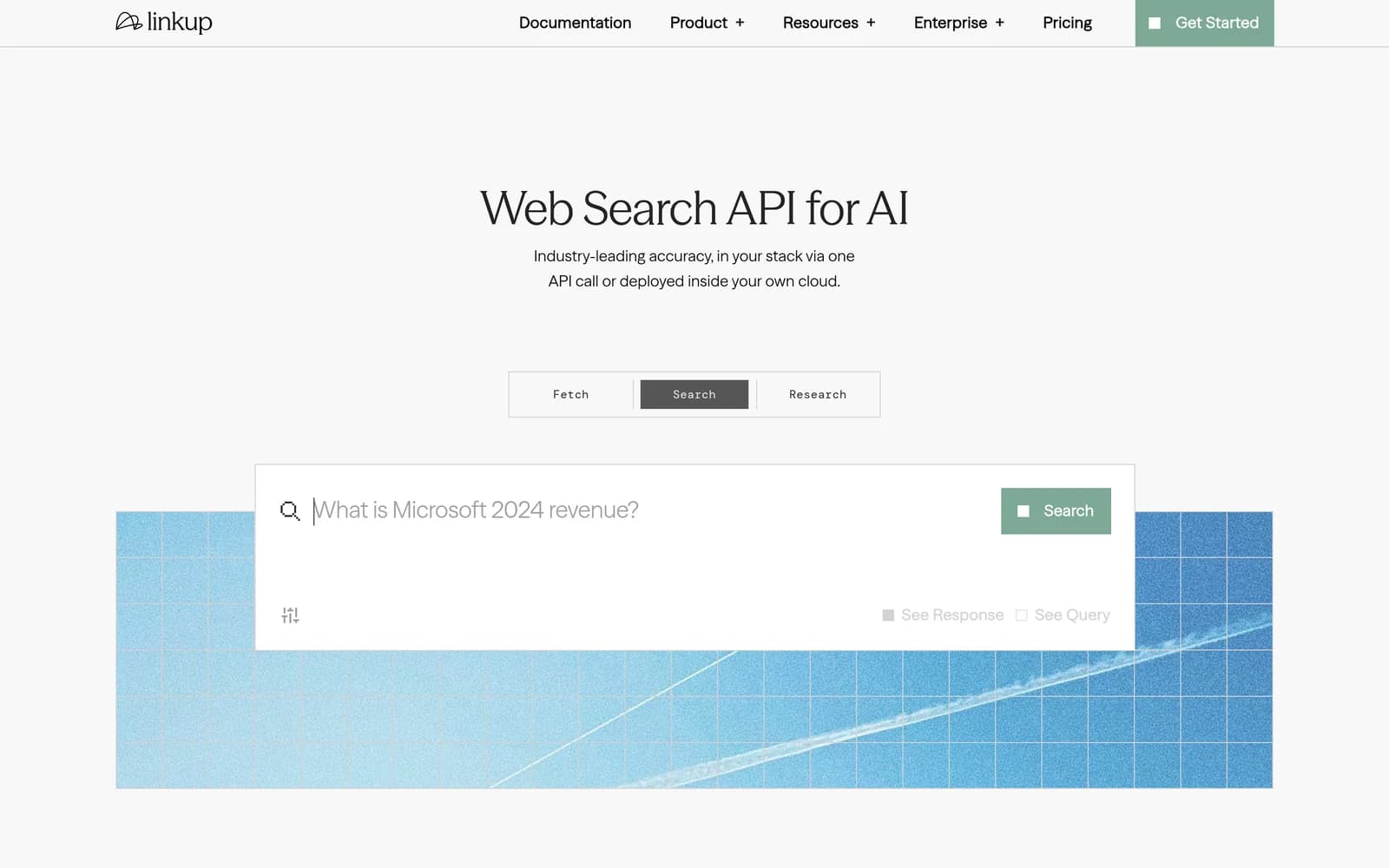
Linkup is a search API that returns a cited answer or JSON in a schema you define, at $5 to $6 per 1,000 requests, with one to three seconds of latency. It also offers content extraction endpoints, asynchronous deep research, and SOC 2 Type II compliance on every plan.
Key features
- Schema-defined output. Declare the shape you want in the call and skip the parsing code.
- Cited answers. Sources returned with the answer in one synchronous call.
- Extraction and research. Page content at $1 to $5 per 1,000 requests; asynchronous deep research at $0.25 to $2.50 per query.
- Compliance on every plan. SOC 2 Type II across all tiers, with zero data retention for enterprise customers.
Comparison with You.com
Linkup and You.com are two of the few APIs here with published SOC 2 Type II compliance on every plan, so Linkup is the natural swap for teams that chose You.com on compliance. It returns a cited answer or schema-defined JSON at $5 to $6 per 1,000 requests. No benchmark numbers are published.
| Feature | Linkup | You.com API |
|---|---|---|
Self-service access Direct setup without contacting sales | Yes | Yes |
Free usage tier Included usage before paid plans | Not applicable | Yes |
Search cost Price per 1,000 requests | $5 to $6 | $5 per 1,000 calls |
Full text in results Extracted content returned in response | Yes | No |
Single-call cited answer Combined data retrieval and answer synthesis | Yes | Yes |
Schema-defined output JSON output formatted to custom specifications | Yes | No |
URL content extraction Parses text directly from user-provided URLs | Yes | Yes |
- Free usage tier: You.com API provides $100 in credit.
- Full text in results: You.com API bills Contents separately.
- Single-call cited answer: You.com API offers Answer endpoint.
- URL content extraction: You.com API offers Contents at $1 per 1,000 pages.
Key technical differences between Linkup and You.com
- Linkup returns a cited answer or schema-defined JSON. You.com returns links, with Answer as a separate endpoint.
- Linkup charges $5 to $6 per 1,000 requests; You.com charges $5 per 1,000 calls with up to a hundred results each.
- Linkup publishes no free tier. You.com gives $100 in credit.
- Linkup states one to three seconds of latency. You.com publishes none.
Key similarities between Linkup and You.com
- Both publish SOC 2 and zero data retention.
- Both return a cited answer in one call.
- Both have a content-extraction endpoint for URLs you already hold.
- Neither has been benchmarked by Exa, so the measured rows are omitted for both.
Linkup primary use cases
Teams pick Linkup when they need cited answers, compliance certifications, or JSON in a fixed shape for downstream systems.
Bottom line
Linkup fits teams that chose You.com for compliance and want output in a fixed schema. It does not match You.com's link volume per call.
Nimble: Web scraping and data collection APIs
- Founded
- 2019
- Similar to
- Exa, You.com API
- Typical users
- Engineers who want search and extraction from one vendor
- Typical customers
- Enterprises collecting web data at scale
What is Nimble?
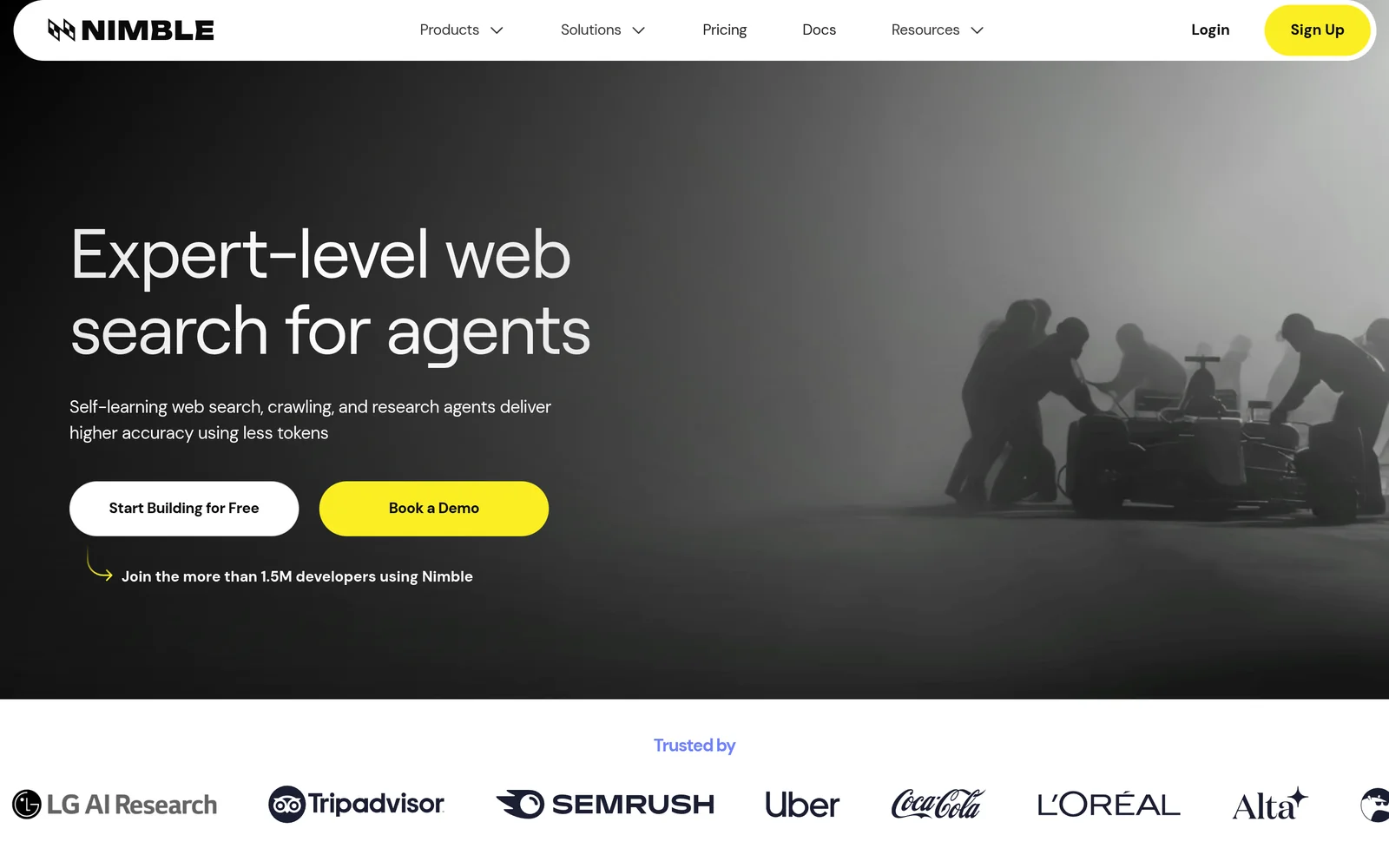
Nimble sells search and web extraction for AI agents through Search, Agents, Extract, Extract Template, Crawl, Map, and Media endpoints. Search costs $5 per 1,000 queries; Extract, Crawl, and Map cost $1 per 1,000 requests.
Extract Template costs $3 per 1,000 requests, and media downloads cost $2 per gigabyte. Accounts get 5,000 free requests a month. Nimble's search pricing matches Exa and You.com, and its own comparison articles rank well in searches for these vendors.
Key features
- Search and crawl pricing. Search at $5 per 1,000 queries; Extract, Crawl, and Map at $1 per 1,000 requests each.
- Largest free tier here. 5,000 free requests a month, the most of any provider on this page.
- Schema extraction. Extract Template at $3 per 1,000 queries returns data in a schema you define.
- Media downloads. Images and other standalone files at $2 per gigabyte.
Comparison with You.com
Nimble has the same scope as You.com and Exa, with search and document extraction under one account, and matches You.com's $5 per 1,000 search price. Its own marketing content ranks well for vendor comparisons, but it publishes no benchmark numbers. Neither Nimble nor You.com says where its index comes from, whether it searches by meaning, or what its rate limits are.
| Feature | Nimble | You.com API |
|---|---|---|
Self-service access Direct setup without contacting sales | Yes | Yes |
Free usage tier Included usage before paid plans | Yes | Yes |
Search cost Price per 1,000 requests | $5 | $5 per 1,000 calls |
Full text in results Extracted content returned in response | No | No |
Single-call cited answer Combined data retrieval and answer synthesis | No | Yes |
Schema-defined output JSON output formatted to custom specifications | Yes | No |
URL content extraction Parses text directly from user-provided URLs | Yes | Yes |
- Free usage tier: Nimble provides 5,000 monthly requests; You.com API provides $100 in credit.
- Full text in results: Nimble bills Extract separately; You.com API bills Contents separately.
- Single-call cited answer: You.com API offers Answer endpoint.
- Schema-defined output: Nimble offers Extract Template.
- URL content extraction: Nimble offers Extract at $1 per 1,000; You.com API offers Contents at $1 per 1,000 pages.
Key technical differences between Nimble and You.com
- Nimble sells Agents, Crawl, Map, and Media alongside search. You.com sells Search, Contents, and Answer.
- Nimble bills Extract, Crawl, and Map at $1 per 1,000 each. You.com bills Contents at $1 per 1,000 pages.
- Nimble gives 5,000 free requests a month. You.com gives $100 in credit once.
- Nimble's Extract Template returns structured output at $3 per 1,000. You.com has no schema output.
Key similarities between Nimble and You.com
- Both charge $5 per 1,000 on search.
- Both bill content separately from search.
- Both target agents rather than people.
- Neither says whether it runs its own index or matches by meaning.
Nimble primary use cases
Nimble fits large web data collection programs where one account should cover both search and structured extraction.
Bottom line
Nimble puts search and extraction on one bill and renews its free tier every month. Applications that want many links per call and a large one-time signup credit get more from You.com.
Firecrawl: Web crawling and extraction APIs for AI
- Founded
- 2022
- Similar to
- Crawl4AI, Apify
- Typical users
- Engineers who start from URLs rather than from a question
- Typical customers
- Teams crawling known sites into a knowledge base
What is Firecrawl?
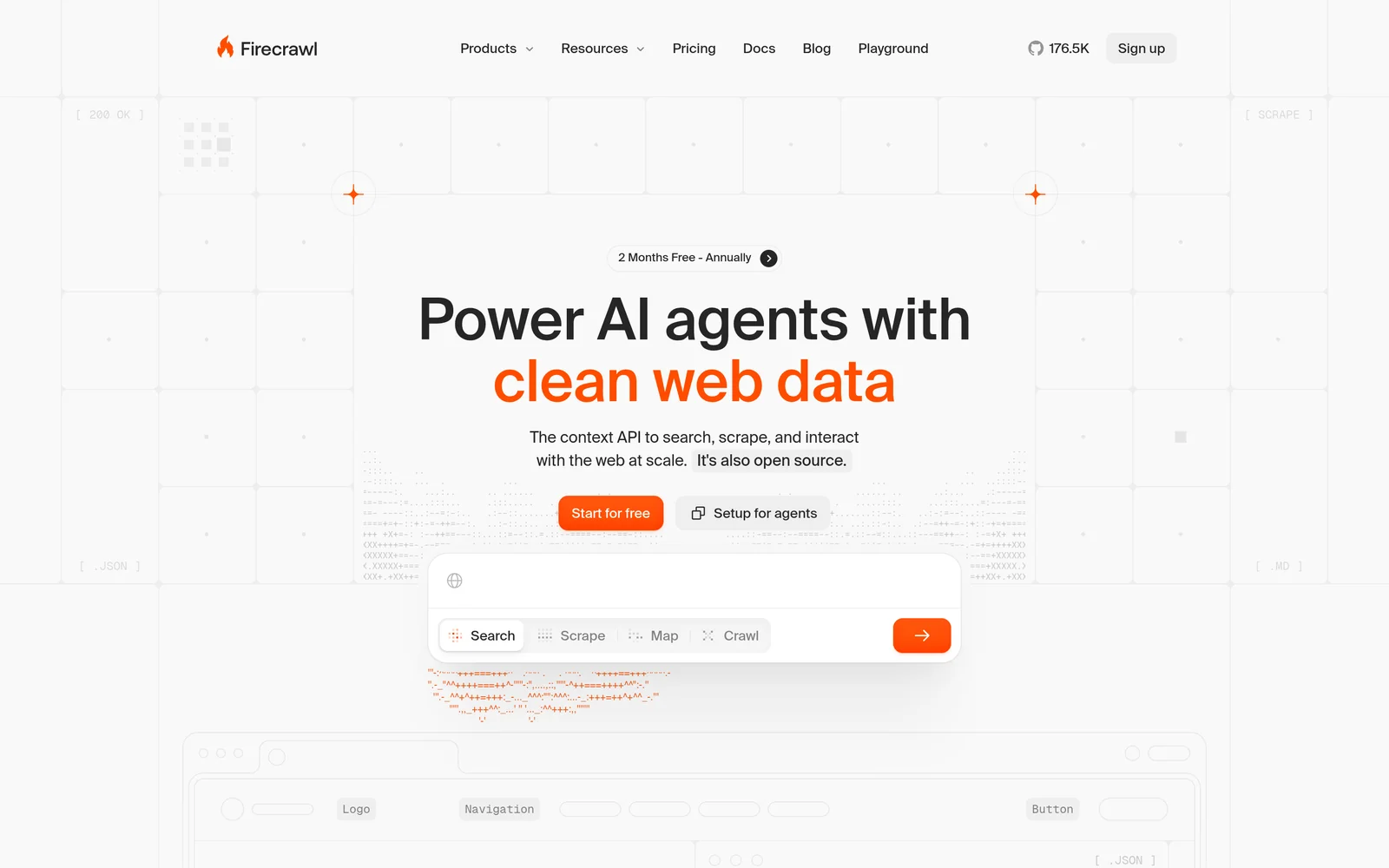
Firecrawl turns websites into clean Markdown or structured JSON. Give it a URL and it renders the page, runs the JavaScript, strips boilerplate, and returns text ready for a prompt.
Give it a domain and it crawls every reachable page. It also has a search endpoint billed at two credits per ten results. Firecrawl shows up on retrieval lists, but its job is document extraction, not web-wide discovery.
Key features
- Scrape and crawl. Clean text from one URL or a whole site, one credit per page.
- Structured extraction. JSON output in a schema you define.
- JavaScript rendering. Handles dynamic pages that index-based search tools miss.
- Subscription pricing. 1,000 free credits a month with two concurrent requests, then $16 for 5,000, $83 for 100,000, and $333 for 500,000 credits. Only successful calls are billed.
Comparison with You.com
Firecrawl handles the step You.com leaves to you: once you have the links, something has to fetch and parse the pages. Firecrawl does that with full JavaScript rendering, and it has a search endpoint with benchmark numbers. Many teams run both.
| Feature | Firecrawl | You.com API |
|---|---|---|
Self-service access Direct setup without contacting sales | Yes | Yes |
Free usage tier Included usage before paid plans | Yes | Yes |
Search cost Price per 1,000 requests | Subscription, from $16 a month for 5,000 credits | $5 per 1,000 calls |
Full text in results Extracted content returned in response | Yes | No |
Single-call cited answer Combined data retrieval and answer synthesis | No | Yes |
Schema-defined output JSON output formatted to custom specifications | Yes | No |
URL content extraction Parses text directly from user-provided URLs | Yes | Yes |
Published rate limits Publicly documented query throughput limits | 10 a minute on free plan | Not applicable |
- Free usage tier: Firecrawl provides 1,000 monthly credits; You.com API provides $100 in credit.
- Full text in results: You.com API bills Contents separately.
- Single-call cited answer: You.com API offers Answer endpoint.
- URL content extraction: Firecrawl includes JavaScript rendering; You.com API offers Contents at $1 per 1,000 pages.
Key technical differences between Firecrawl and You.com
- Firecrawl reads pages you specify. You.com finds pages for a query.
- Firecrawl is subscription-priced from $16 a month for 5,000 pages; You.com bills $5 per 1,000 calls.
- Firecrawl returns Markdown or schema-defined JSON. You.com returns links.
- Firecrawl's search endpoint returned the top result in 41.6% of profile-lookup queries at 1.4 seconds. You.com has not been measured.
Key similarities between Firecrawl and You.com
- Both offer a free tier or credit that covers a prototype.
- Both sit inside agent pipelines rather than serving people directly.
- Both have an extraction product for URLs you already hold.
- Both bill by unit of work: calls on You.com, credits on Firecrawl.
Firecrawl primary use cases
Firecrawl converts dynamic web applications into Markdown or JSON, which suits indexing specific domains and reading client-side rendered pages.
Bottom line
Firecrawl is strong when the workflow starts with a list of URLs. It takes over fetching while You.com handles discovery. A complete retrieval stack still needs a search API to find the pages.
Which You.com API alternative should you choose?
- If you want the right page first, with its text attached and ranked by meaning, choose Exa.
- If you are handing users a cited answer and never touch the source documents, choose Perplexity Sonar.
- If you want cleaned snippets and a monthly free tier at prototype cost, choose Tavily.
- If you want links from an independent index at the same price with a monthly credit, choose Brave Search API.
- If you chose You.com on compliance and want output in a fixed shape, choose Linkup.
- If you want search and extraction from one vendor with a monthly free tier, choose Nimble.
- If you have the URLs and need them read with JavaScript rendered, choose Firecrawl.
Is Exa right for you?
Exa is built for AI agent workflows. Choose it if:
- You want the right page first, with its text attached, instead of a hundred links to fetch.
- You search for people, companies, or research papers. These are the categories where Exa's measured lead is largest.
- You want to test before you pay. The free tier gives $10 in credit a month plus a $10 onboarding bonus, with no credit card. You can also start through Exa MCP without an API key.
Getting started costs nothing. Get an API key at dashboard.exa.ai and run:
curl -X POST https://api.exa.ai/search \-H "x-api-key: YOUR_KEY" \-H "Content-Type: application/json" \-d '{"query": "search APIs for AI agents"}'