The best Perplexity API alternatives & competitors, compared
Updated
Perplexity's Sonar API returns a cited answer in one call, handling retrieval and synthesis itself.
That makes integration simple, but teams still look for alternatives when they need lower costs at scale, more control over retrieval, or the source documents themselves rather than a finished answer.
That distinction matters when search is one step inside a larger application. A generated answer is useful when it is the final output, but agents and retrieval pipelines often need the underlying page content so they can extract data, apply their own logic, or pass it to another model.
This guide compares six search and answer APIs on features, benchmark results, pricing, and where each one fits.
Exa: Web search, research, and retrieval APIs for AI agents
- Founded
- 2021
- Similar to
- Tavily, Brave Search API
- Typical users
- Developers creating software agents and data retrieval systems
- Typical customers
- Early-stage AI companies and software development platforms
What is Exa?
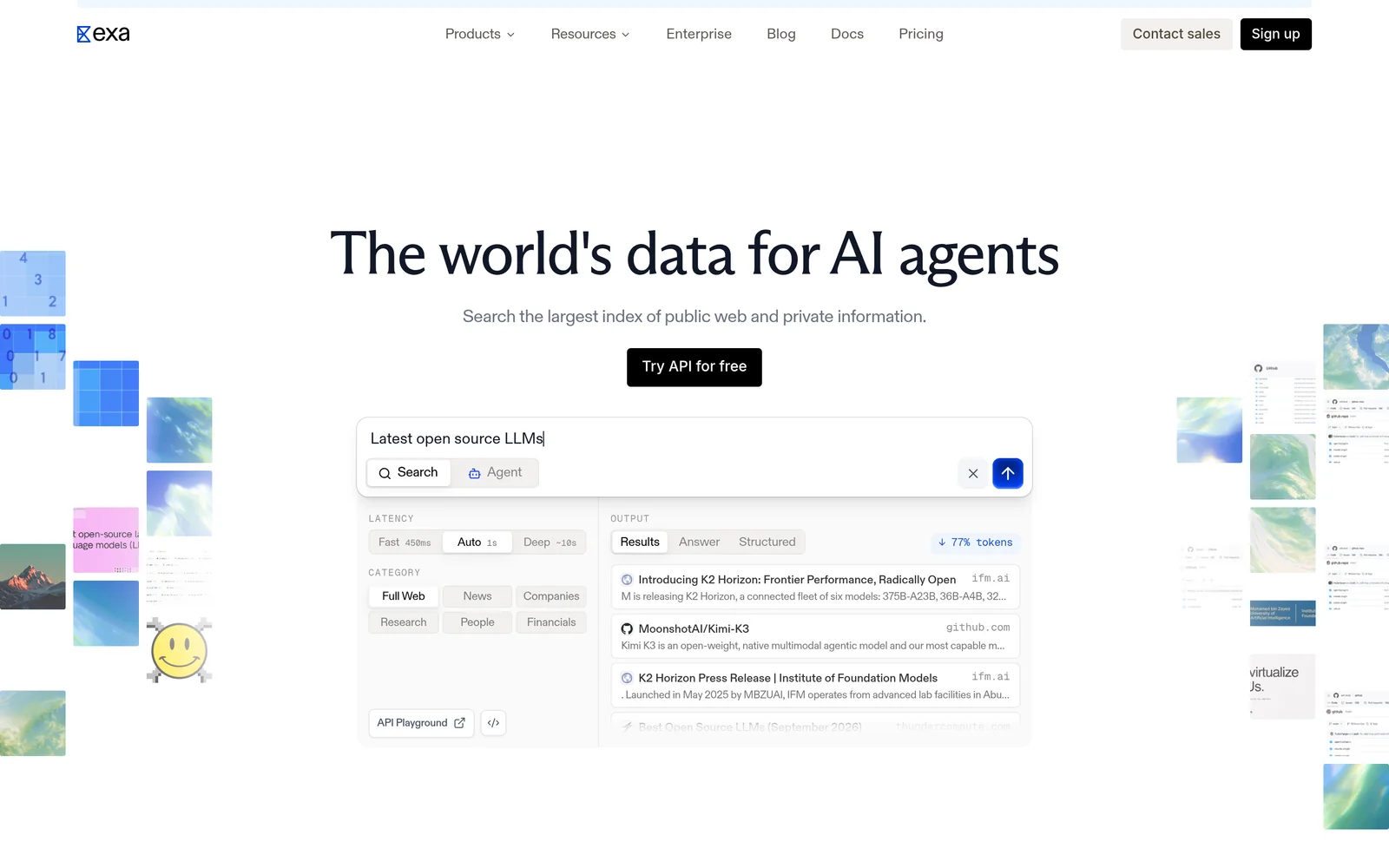
Exa is a search engine built for software rather than people. Given a query, it searches its own index and returns ranked results with extracted page text and highlights. Because the search is semantic, a prompt like "startups building humanoid robots in Europe" works as written.
Beyond search, Exa offers Contents for extracting text from URLs you already have, Answer for a cited response in one call, Deep Search for multi-step research, and Monitors for tracking new content on a topic.
Key features
- Search by meaning. Neural search over its own index. Auto, the default search type, picks the best method for each query.
- Page content included in responses. Search starts at $4 per 1,000 requests (Lite); Auto is $7. Both include extracted text and highlights for up to ten results. Most alternatives return links and bill separately for content.
- Category-specific search. Filters for companies, people, and publications, with structured metadata.
- Answer and Deep Search. Cited answers cost $5 per 1,000 requests. Multi-step research runs cost $12 per 1,000.
- Contents and Monitors. Extracting text from URLs you already have costs $1 per 1,000 pages. Scheduled searches that watch a topic cost $15 per 1,000.
- Published rate limits. 10 queries per second on Search, 100 on Contents, and 10 on Answer.
Comparison with Sonar
Exa gives you the retrieval layer; Sonar hides it in exchange for simplicity. Exa's Answer endpoint returns a one-call answer at $5 per 1,000 requests, and its Search endpoint lets an application with its own model do the synthesis itself, which Sonar does not allow.
| Feature | Exa | Perplexity Sonar |
|---|---|---|
Self-service access Direct setup without contacting sales | Yes | Yes |
Free usage tier Included usage before paid plans | Yes | Not applicable |
Search cost Price per 1,000 requests | From $4, content included | Not applicable |
Full text in results Extracted content returned in response | Yes | No |
Proprietary web index Independent crawl rather than a third-party wrapper | Yes | Not applicable |
Semantic search Meaning-based retrieval instead of strict keywords | Yes | Not applicable |
Single-call cited answer Combined data retrieval and answer synthesis | Yes | Yes |
Schema-defined output JSON output formatted to custom specifications | Yes | No |
URL content extraction Parses text directly from user-provided URLs | Yes | Yes |
Published rate limits Publicly documented query throughput limits | 10 QPS on Search, custom Enterprise limits | Not applicable |
Median latency Measured response speed in benchmark testing | 472 ms | 1.3 s |
Entity lookup accuracy Top-result retrieval precision in benchmark testing | 75.5% | 53.5% |
- Free usage tier: Exa offers $10 a month plus a $10 onboarding bonus, plus free access through Exa MCP with no API key required.
- Full text in results: Exa includes text and highlights; Perplexity Sonar returns only the answer.
- Single-call cited answer: Exa offers Answer at $5 per 1,000 requests.
- Schema-defined output: Exa via outputSchema on Answer and JSON-schema summaries on Contents.
- URL content extraction: Exa offers Contents at $1 per 1,000 pages; Perplexity Sonar uses a fetch tool.
Key technical differences between Exa and Sonar
- Exa returns the source documents with extracted text, plus an optional synthesis endpoint. Sonar returns one written answer and keeps the sources.
- Your code can re-rank, re-chunk, and store what Exa returns. Sonar's retrieved content never leaves Perplexity.
- Exa Search starts at $4 per 1,000 queries. Answer is $5 per 1,000. Sonar's base per-request price could not be verified.
- In benchmarks, Exa scored 75.5% on people lookups and 81.5% on company lookups against Sonar's 53.5% and 69.3%, and 66.5% against 45.1% on research papers.
Key similarities between Exa and Sonar
- Both offer a one-call endpoint that returns a cited answer.
- Both bill per request.
- Both feed live web content to a model.
- Both run retrieval on the vendor's side, so you host no index.
Exa primary use cases
Across 200 people lookups, Exa found the right profile first 75.5% of the time and Sonar 53.5%, with a median latency of 472 milliseconds against Sonar's 1.3 seconds. On company queries in the same run, Exa scored 81.5% and Sonar 69.3%. On a separate set of 597 research papers, Exa scored 66.5% and Sonar 45.1%. Teams that move from Sonar most often cite one reason: they want the source documents, not only the answer.
Bottom line
Exa fits pipelines that need control over answer generation, entity lookup, or a cited answer without giving up the documents. Applications that only need a finished summary can use one of the providers below.
Brave Search API: Independent web search API
- Founded
- 2021
- Similar to
- Exa, Bing Search API
- Typical users
- Engineers who want an index that is not Google's
- Typical customers
- Privacy-focused products with their own extraction layer
What is Brave Search API?
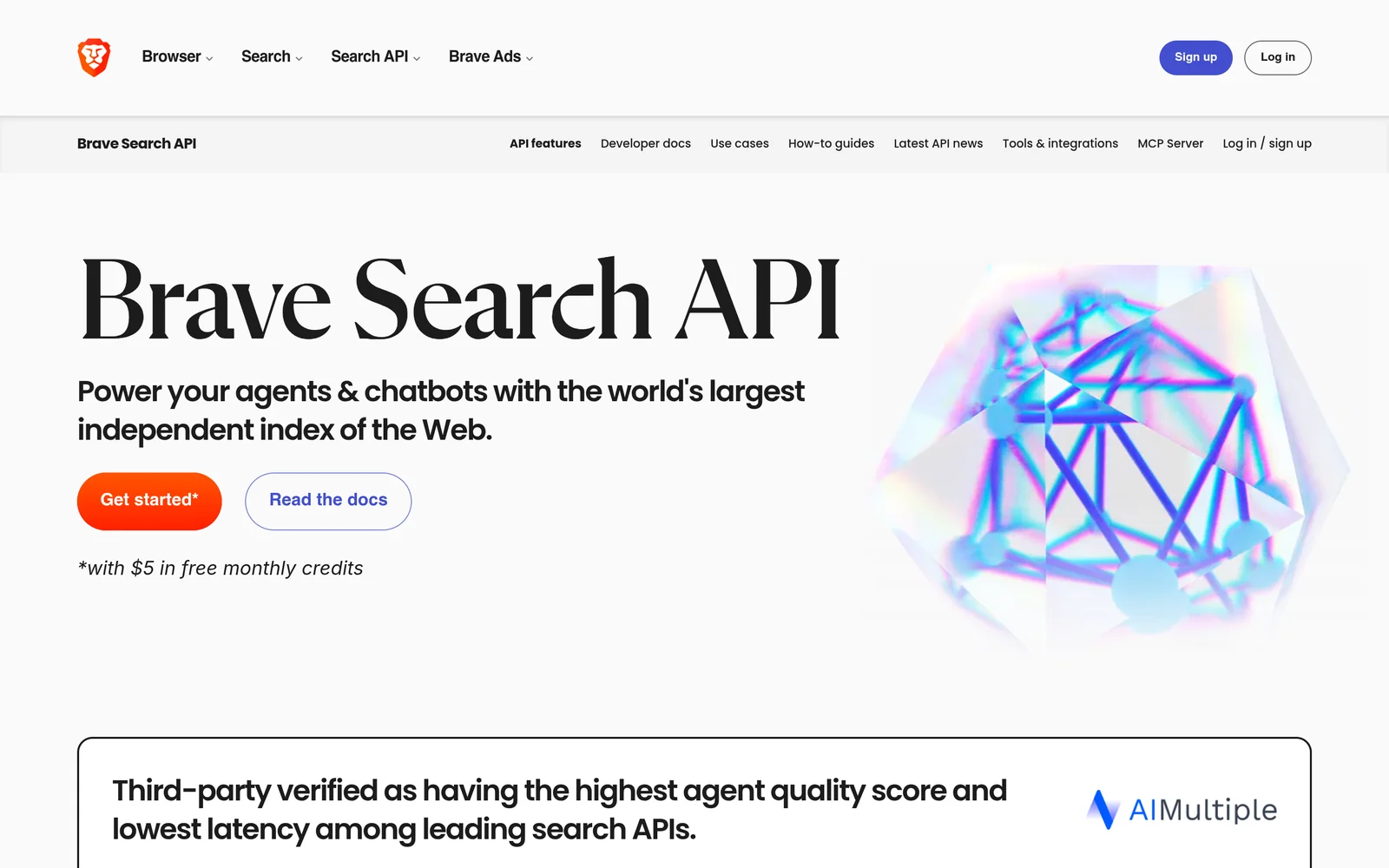
The Brave Search API gives developers access to Brave's own web index, which it runs itself rather than pulling results from Google or Bing. It returns ranked results at $5 per 1,000 requests and includes an AI Grounding endpoint for cited answers. It is the only alternative in this guide that shares Exa's defining trait: a search index it built itself.
Key features
- Independent index. Brave crawls the web itself rather than wrapping another engine.
- $5 per 1,000 requests, with a $5 monthly credit.
- AI Grounding. Cited answers at $4 per 1,000 requests, plus $5 per million input and output tokens.
- Speed. A median of about 650 milliseconds in benchmarks.
Comparison with Sonar
Brave is the budget option. At $5 per 1,000 requests on its own index, it ties You.com for the lowest verified base rate, and it returns links rather than an answer. Teams that leave Sonar over cost often land on Brave and rebuild the fetch-and-clean step Sonar used to handle.
| Feature | Brave Search API | Perplexity Sonar |
|---|---|---|
Self-service access Direct setup without contacting sales | Yes | Yes |
Free usage tier Included usage before paid plans | Yes | Not applicable |
Search cost Price per 1,000 requests | $5 | Not applicable |
Full text in results Extracted content returned in response | No | No |
Proprietary web index Independent crawl rather than a third-party wrapper | Yes | Not applicable |
Semantic search Meaning-based retrieval instead of strict keywords | No | Not applicable |
Single-call cited answer Combined data retrieval and answer synthesis | Yes | Yes |
Schema-defined output JSON output formatted to custom specifications | No | No |
URL content extraction Parses text directly from user-provided URLs | No | Yes |
- Free usage tier: Brave Search API offers $5 in credits a month.
- Full text in results: Brave Search API is billed separately for full text; Perplexity Sonar returns only the answer.
- Semantic search: Brave Search API uses keyword search.
- Single-call cited answer: Brave Search API offers AI Grounding.
- URL content extraction: Perplexity Sonar uses a fetch tool.
Key technical differences between Brave and Sonar
- Brave returns links from its own index. Sonar returns a written answer with citations.
- Brave publishes $5 per 1,000 requests. Sonar's base per-request price could not be verified.
- Brave gives $5 in credit every month. Sonar has no published free tier.
- Brave measured a median of about 650 milliseconds. Sonar measured 1.3 seconds on people lookups.
Key similarities between Brave and Sonar
- Both sell a cited-answer product; Brave's is AI Grounding at $4 per 1,000 queries plus token fees.
- Both bill per request.
- Both ground a model with live web content.
- Neither does semantic search.
Brave Search API primary use cases
Brave suits teams that already have a collection pipeline and want a fast, non-Google index with plain per-request pricing.
Bottom line
Brave fits cost-conscious teams with their own scraping infrastructure, and matches You.com on base price. Teams that want a finished answer should look at Brave's AI Grounding rather than its plain search.
You.com API: Web search and research APIs
- Founded
- 2020
- Similar to
- Brave Search API, Exa
- Typical users
- Engineers who want many results per call
- Typical customers
- Teams with SOC 2 and zero-data-retention requirements
What is You.com API?
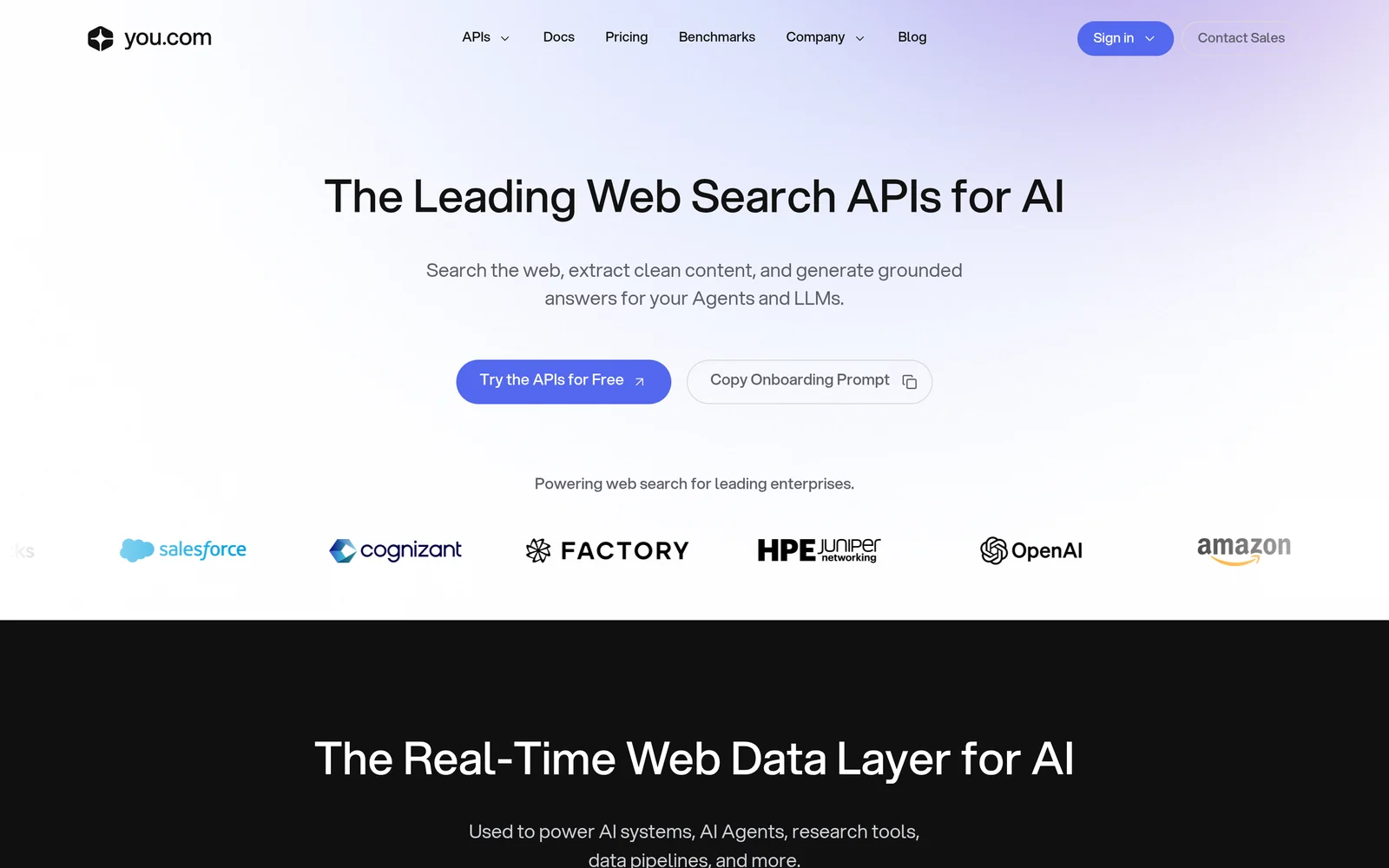
You.com sells a Web Search API at $5 per 1,000 calls that returns 1 to 100 results per query, a Contents endpoint at $1 per 1,000 pages, and an Answer endpoint at $5 per 1,000 calls. New accounts get $100 in credit. The pricing page lists SOC 2 compliance and zero-data-retention options.
Key features
- Up to 100 results per call. One $5-per-1,000 request covers what other search APIs split across several billable calls.
- Contents and Answer endpoints. $1 per 1,000 pages for extracted text and $5 per 1,000 queries for cited answers.
- $100 in signup credit, the largest starting credit of any provider here.
- SOC 2 and zero data retention. Listed on the public pricing page.
Comparison with Sonar
You.com splits apart what Sonar bundles: a Web Search API at $5 per 1,000 calls with up to 100 results per request, a page extraction endpoint, and an Answer endpoint at $5 per 1,000 queries. Its pricing page also lists SOC 2 compliance and zero-data-retention options.
| Feature | You.com API | Perplexity Sonar |
|---|---|---|
Self-service access Direct setup without contacting sales | Yes | Yes |
Free usage tier Included usage before paid plans | Yes | Not applicable |
Search cost Price per 1,000 requests | $5 per 1,000 calls | Not applicable |
Full text in results Extracted content returned in response | No | No |
Single-call cited answer Combined data retrieval and answer synthesis | Yes | Yes |
Schema-defined output JSON output formatted to custom specifications | No | No |
URL content extraction Parses text directly from user-provided URLs | Yes | Yes |
- Free usage tier: You.com API offers $100 in credit.
- Full text in results: You.com API charges for Contents separately; Perplexity Sonar returns only the answer.
- Single-call cited answer: You.com API provides Answer.
- URL content extraction: You.com API offers Contents at $1 per 1,000 pages; Perplexity Sonar uses a fetch tool.
Key technical differences between You.com and Sonar
- You.com returns ranked results, 1 to 100 links per call. Sonar returns one written answer.
- You.com publishes $5 per 1,000 search calls and $5 per 1,000 answer queries. Sonar's base rates could not be verified.
- You.com gives $100 in credit at signup. Sonar has no published free tier.
- You.com lists SOC 2 and zero data retention on its pricing page. Sonar does not.
Key similarities between You.com and Sonar
- Both offer a one-call endpoint that returns a cited answer.
- Both bill per request.
- Both ground a model with live web content.
- Neither says whether it runs its own web index.
You.com API primary use cases
You.com fits broad collection jobs that want many results per request, and teams whose security review needs SOC 2 and zero data retention on paper.
Bottom line
You.com fits teams that want the pieces sold separately, an optional answer endpoint, and compliance paperwork. Its retrieval accuracy has not been measured in a public benchmark.
Tavily: Web search API for AI agents
- Founded
- 2023
- Similar to
- Exa, Linkup
- Typical users
- Engineers building LLM apps and RAG pipelines
- Typical customers
- Prototypes and early-stage agent products
What is Tavily?
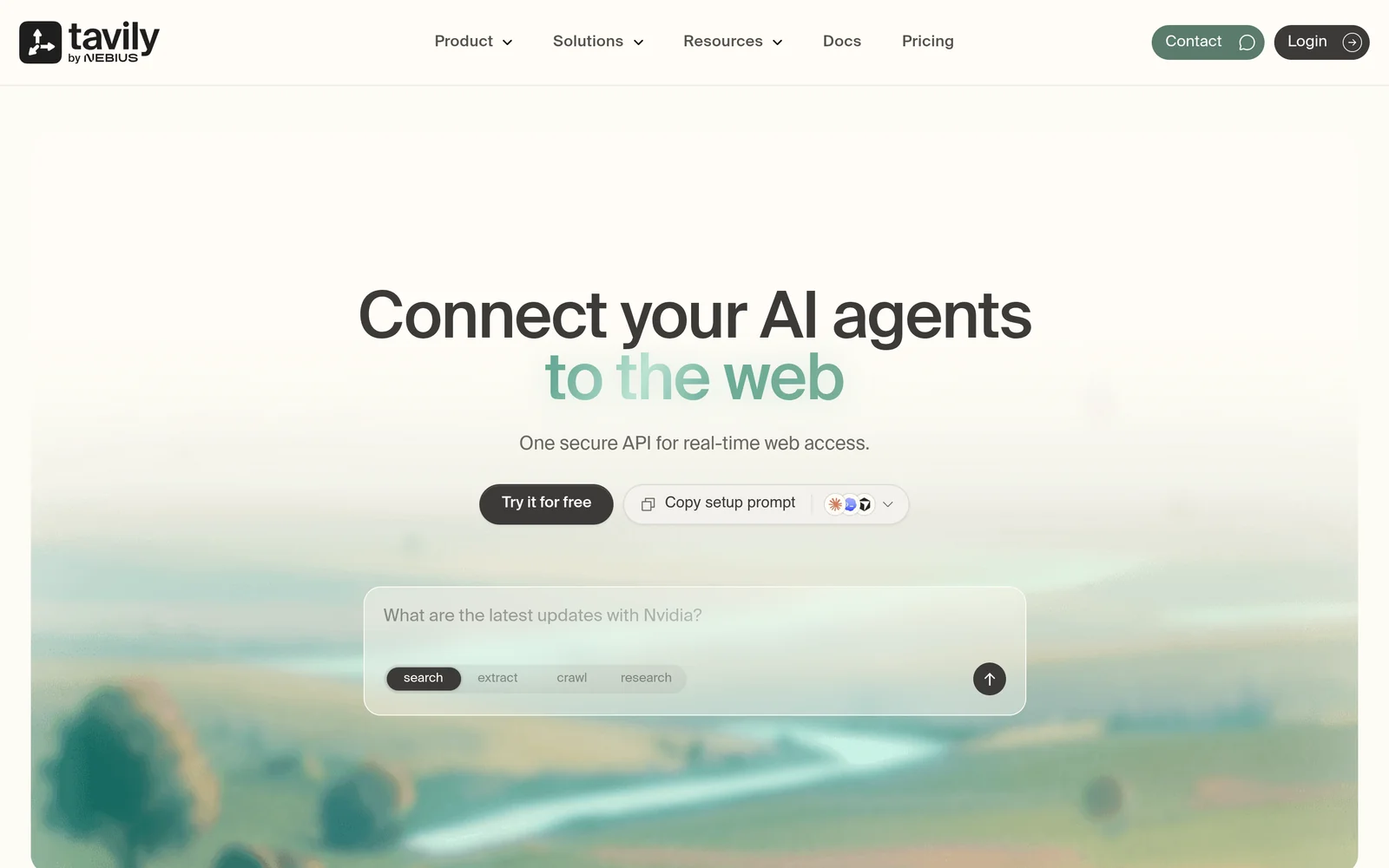
Tavily is a web search API for language models and retrieval-augmented generation pipelines. It returns context that is already cleaned, deduplicated, and trimmed to a token limit, so it can go straight into a prompt. An extract endpoint pulls text from URLs you supply. The free plan gives 1,000 credits a month; paid plans run from $30 to $500 a month.
Key features
- Agent-ready context. Results as prompt-sized snippets with page boilerplate removed.
- Extract endpoint. Text from URLs you supply, alongside search.
- Credit pricing. $0.008 per credit pay-as-you-go, falling to $0.0075 and $0.005 on monthly plans from $30 to $500.
- Free tier. 1,000 credits a month, no card required.
Comparison with Sonar
Tavily returns cleaned, deduplicated snippets for your model to read, which puts it between Sonar's finished answers and Brave's raw links. It gives 1,000 free credits a month and is quick to set up, but it scored below Sonar on people lookups.
| Feature | Tavily | Perplexity Sonar |
|---|---|---|
Self-service access Direct setup without contacting sales | Yes | Yes |
Free usage tier Included usage before paid plans | Yes | Not applicable |
Search cost Price per 1,000 requests | $8 pay-as-you-go, $5 to $7.50 on plans | Not applicable |
Full text in results Extracted content returned in response | Yes | No |
Single-call cited answer Combined data retrieval and answer synthesis | Not applicable | Yes |
Schema-defined output JSON output formatted to custom specifications | No | No |
URL content extraction Parses text directly from user-provided URLs | Yes | Yes |
Median latency Measured response speed in benchmark testing | 3.6 s | 1.3 s |
Entity lookup accuracy Top-result retrieval precision in benchmark testing | 40.5% | 53.5% |
- Free usage tier: Tavily provides 1,000 credits a month.
- Full text in results: Tavily provides full text as snippets; Perplexity Sonar returns only the answer.
- URL content extraction: Tavily offers an extract endpoint; Perplexity Sonar uses a fetch tool.
Key technical differences between Tavily and Sonar
- Tavily returns cleaned snippets for your model to process. Sonar returns Perplexity's finished answer.
- Tavily charges $8 per 1,000 credits pay-as-you-go. Sonar's base price could not be verified.
- Tavily gives 1,000 free credits a month. Sonar has no published free tier.
- On people lookups, Tavily placed the right result first 40.5% of the time at 3.6 seconds; Sonar scored 53.5% at 1.3 seconds.
Key similarities between Tavily and Sonar
- Both run retrieval on the vendor's side.
- Both target software agents rather than people.
- Both have a tool for extracting content from URLs you supply.
- Both bill per request or credit.
Tavily primary use cases
Teams pick Tavily for prototypes and early agent work, where a free tier and quick setup matter more than retrieval precision.
Bottom line
Tavily fits teams that want the source text and a free tier that renews monthly. Where accuracy is the deciding factor, it scored lower in benchmarks.
Serper: Google Search API
- Founded
- Not published
- Similar to
- SerpAPI, SearchApi
- Typical users
- Engineers who need Google's result page as JSON
- Typical customers
- Rank trackers, SERP monitors and Google-only agents
What is Serper?
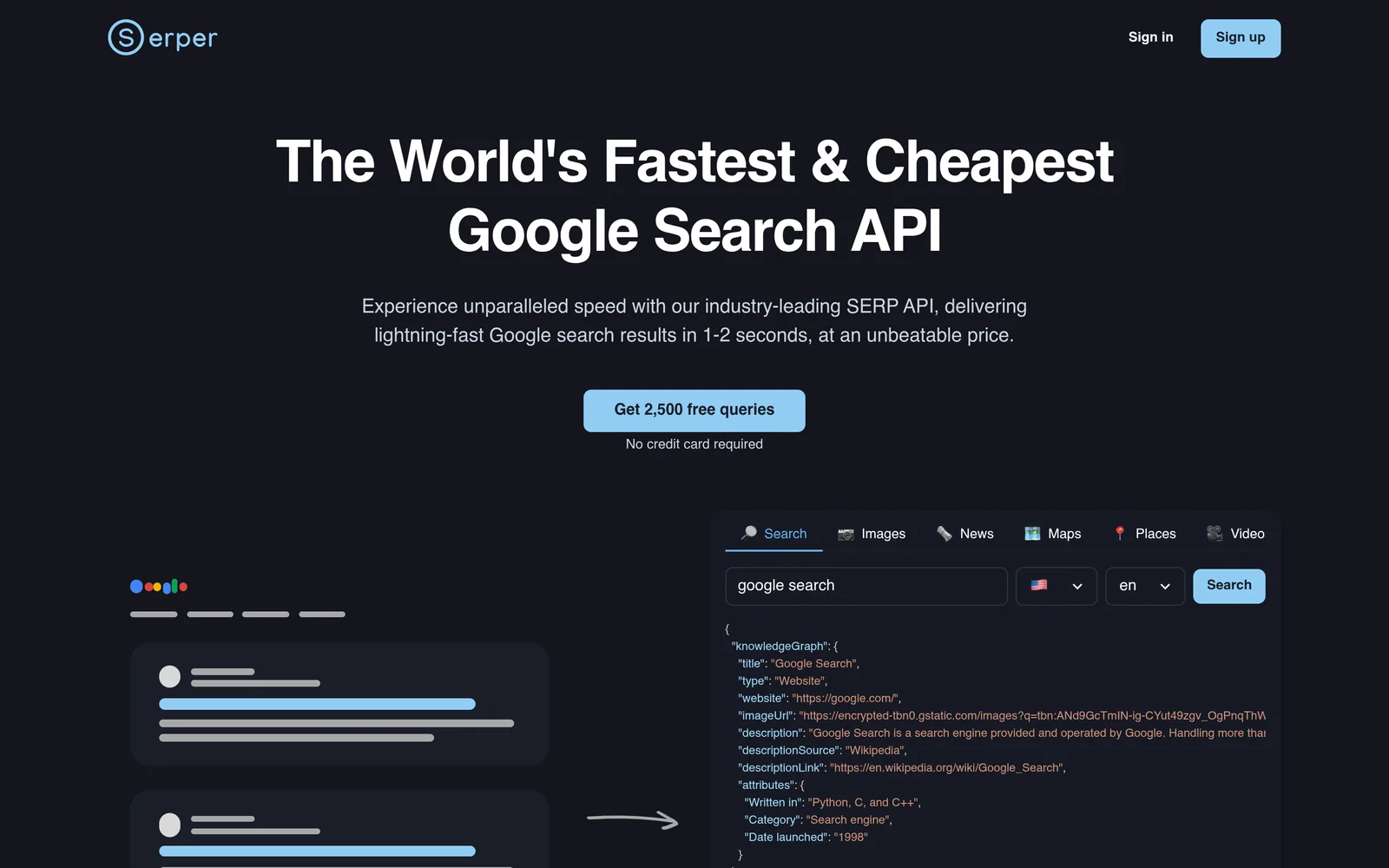
Serper returns Google search result pages as structured JSON, fast and cheap. It covers Google only.
Key features
- Google SERP as JSON. Organic results and SERP features as structured fields.
- Speed. Named across buyer's guides as a fast, cheap way to get Google results.
- Google only. No Bing or other engines; multi-engine retrieval needs a second tool.
- Pricing not verifiable. The pricing page renders client-side, so the base rate could not be confirmed.
Comparison with Sonar
Serper does one narrow job: Google's results page as JSON, fast and cheap, with no answer and no page text. It suits teams measuring search visibility. Teams building retrieval should add the cost of scraping the pages when comparing totals.
| Feature | Serper | Perplexity Sonar |
|---|---|---|
Self-service access Direct setup without contacting sales | Yes | Yes |
Search cost Price per 1,000 requests | Not applicable | Not applicable |
Full text in results Extracted content returned in response | No | No |
Semantic search Meaning-based retrieval instead of strict keywords | No | Not applicable |
Single-call cited answer Combined data retrieval and answer synthesis | No | Yes |
Schema-defined output JSON output formatted to custom specifications | No | No |
URL content extraction Parses text directly from user-provided URLs | No | Yes |
- Full text in results: Perplexity Sonar returns only the answer.
- Semantic search: Serper uses keyword search.
- URL content extraction: Perplexity Sonar uses a fetch tool.
Key technical differences between Serper and Sonar
- Serper returns Google's results page as JSON. Sonar returns a written answer with citations.
- Serper's pricing page renders client-side, so its rates could not be verified. Sonar's base rate is also unconfirmed.
- Serper queries Google's index only. Sonar retrieves through Perplexity's own system.
- Serper has no public benchmark results. Sonar placed the right result first in 53.5% of people lookups.
Key similarities between Serper and Sonar
- Both are self-service with no sales call.
- Both bill per request rather than per seat.
- Neither returns full page content in the search call, so your code scrapes the pages.
- Neither lists verified free-tier details on its main pricing page.
Serper primary use cases
Serper is used for Google-specific rank tracking and SERP monitoring, where the question is how Google displays a query.
Bottom line
Serper is the right choice when you need to see what Google shows, which Sonar does not do. For an answer or the source documents, Serper returns links only.
Linkup: Web search API for AI applications
- Founded
- 2024
- Similar to
- Perplexity Sonar, Exa Answer
- Typical users
- Engineers who want retrieval output already shaped for their code
- Typical customers
- Teams with compliance requirements in the buying process
What is Linkup?
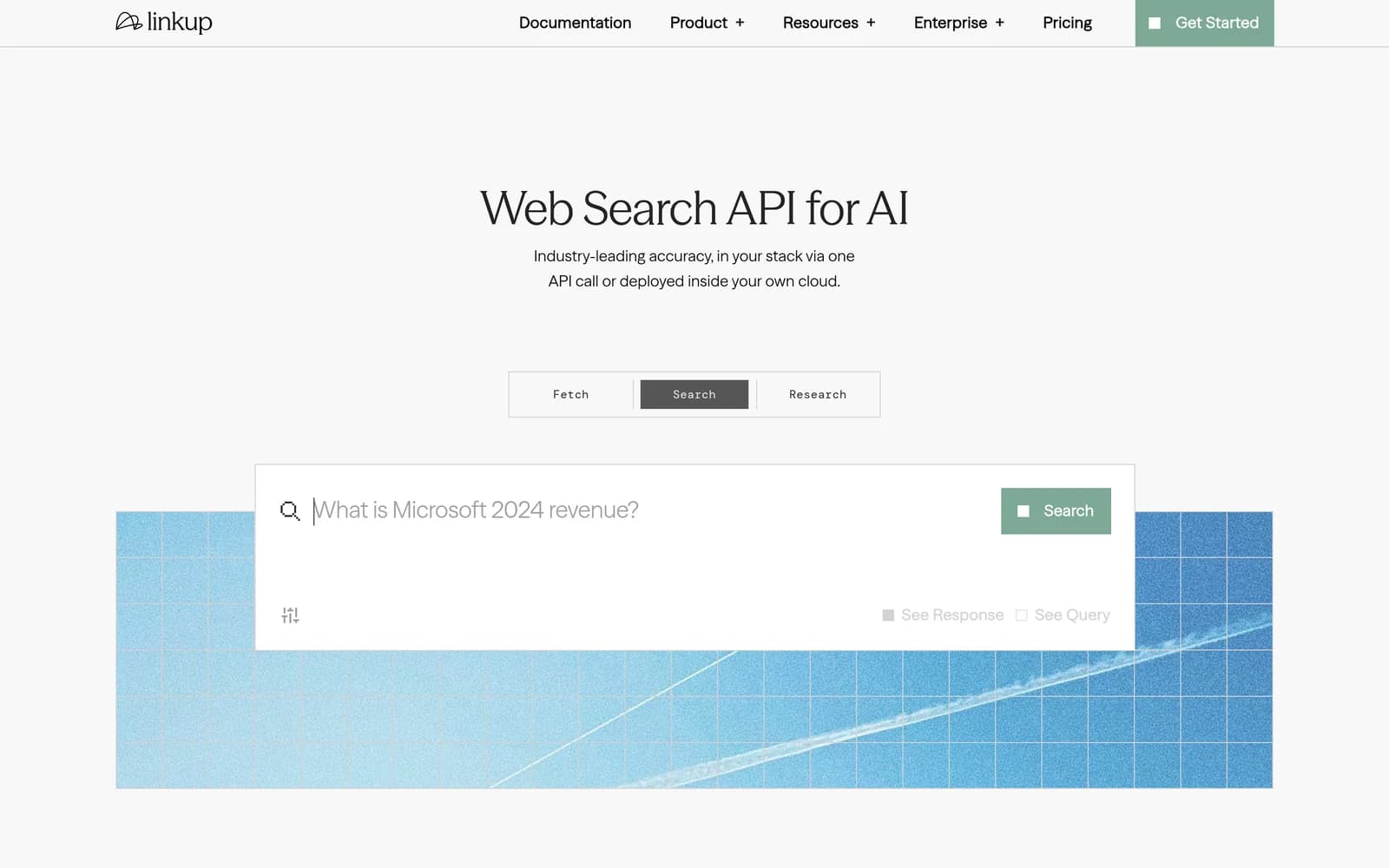
Linkup is a search API for AI applications that returns a cited answer or JSON in a schema you define, at $5 to $6 per 1,000 requests, with one to three seconds of latency. It also has a page-extraction endpoint, an asynchronous research tool for long queries, and SOC 2 Type II compliance on every plan.
Key features
- Schema-defined output. Declare the shape you want in the call and skip the parsing code.
- Cited answers. Sources returned with the answer in one synchronous request.
- Extraction and research. Page content at $1 to $5 per 1,000 requests; asynchronous deep research at $0.25 to $2.50 per query.
- Compliance on every plan. SOC 2 Type II across all tiers, with zero data retention for enterprise accounts.
Comparison with Sonar
Linkup is the closest match to Sonar: a cited answer in one call at a published $5 to $6 per 1,000 requests, with SOC 2 Type II on every plan. It adds JSON output in your schema, which Sonar lacks. It has no public benchmark results.
| Feature | Linkup | Perplexity Sonar |
|---|---|---|
Self-service access Direct setup without contacting sales | Yes | Yes |
Search cost Price per 1,000 requests | $5 to $6 | Not applicable |
Full text in results Extracted content returned in response | Yes | No |
Single-call cited answer Combined data retrieval and answer synthesis | Yes | Yes |
Schema-defined output JSON output formatted to custom specifications | Yes | No |
URL content extraction Parses text directly from user-provided URLs | Yes | Yes |
- Full text in results: Perplexity Sonar returns only the answer.
- URL content extraction: Perplexity Sonar uses a fetch tool.
Key technical differences between Linkup and Sonar
- Linkup publishes $5 to $6 per 1,000 requests. Sonar's base rates are not published in a verifiable form.
- Linkup returns cited answers or JSON in your schema. Sonar returns text answers only.
- Linkup carries SOC 2 Type II on every plan. Sonar does not list it on its main pricing page.
- Linkup has no public benchmark results. Sonar placed the right result first in 53.5% of people lookups.
Key similarities between Linkup and Sonar
- Both return a cited answer in one call.
- Both run retrieval on the vendor's side, so you host no index.
- Both bill per request rather than per seat.
- Neither lists a public free tier on its main pricing page.
Linkup primary use cases
Teams pick Linkup when they need cited answers, compliance certifications, or JSON in a fixed shape.
Bottom line
Linkup fits teams that want Sonar's one-call answer pattern with published pricing and compliance paperwork. Sonar has public benchmark results; Linkup does not.
Firecrawl: Web crawling and extraction APIs for AI
- Founded
- 2022
- Similar to
- Crawl4AI, Apify
- Typical users
- Engineers who start from URLs rather than from a question
- Typical customers
- Teams crawling known sites into a knowledge base
What is Firecrawl?
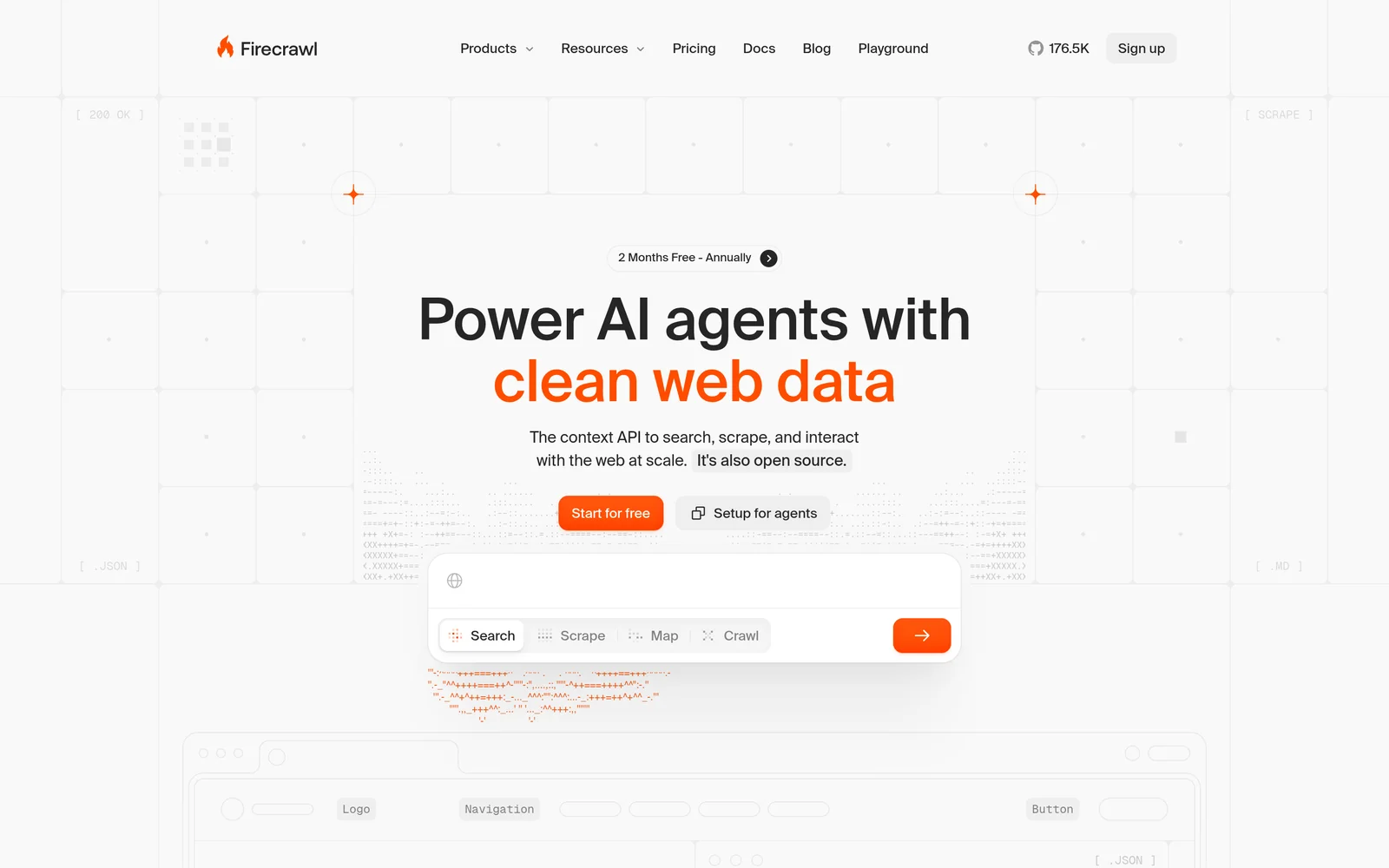
Firecrawl turns web pages into clean Markdown or structured JSON. Give it a URL and it renders the page, JavaScript included, strips the layout, and returns text ready for a prompt.
Give it a domain and it crawls every reachable page. It also has a search endpoint priced at two credits per ten results. Firecrawl appears on most search competitor lists, but its job is document scraping, not web discovery.
Key features
- Scrape and crawl. Clean text from one URL or a whole domain, one credit per page.
- Structured extraction. JSON output in a schema you define.
- JavaScript rendering. Handles dynamic pages that index-based search tools miss.
- Subscription pricing. 1,000 free credits a month with two concurrent connections, then $16 for 5,000, $83 for 100,000, and $333 for 500,000 credits. Only successful requests are billed.
Comparison with Sonar
Firecrawl is the extraction layer in a pipeline: Sonar or a search API finds the sources, and Firecrawl reads the pages. It is built for scraping documents, not for answering questions, which makes it the mirror image of Sonar.
| Feature | Firecrawl | Perplexity Sonar |
|---|---|---|
Self-service access Direct setup without contacting sales | Yes | Yes |
Free usage tier Included usage before paid plans | Yes | Not applicable |
Search cost Price per 1,000 requests | Subscription, from $16 a month for 5,000 credits | Not applicable |
Full text in results Extracted content returned in response | Yes | No |
Single-call cited answer Combined data retrieval and answer synthesis | No | Yes |
Schema-defined output JSON output formatted to custom specifications | Yes | No |
URL content extraction Parses text directly from user-provided URLs | Yes | Yes |
Published rate limits Publicly documented query throughput limits | 10 a minute on free plan | Not applicable |
Median latency Measured response speed in benchmark testing | 1.4 s | 1.3 s |
Entity lookup accuracy Top-result retrieval precision in benchmark testing | 41.6% | 53.5% |
- Free usage tier: Firecrawl provides 1,000 monthly credits.
- Full text in results: Perplexity Sonar returns only the answer.
- URL content extraction: Firecrawl offers extraction with JavaScript rendering; Perplexity Sonar uses a fetch tool.
Key technical differences between Firecrawl and Sonar
- Firecrawl extracts pages you specify into clean Markdown. Sonar writes an answer.
- Firecrawl is a subscription from $16 a month for 5,000 pages. Sonar's base price could not be verified.
- Firecrawl gives 1,000 free credits a month. Sonar has no published free tier.
- Firecrawl's search endpoint placed the right result first in 41.6% of people lookups at 1.4 seconds; Sonar scored 53.5% at 1.3 seconds.
Key similarities between Firecrawl and Sonar
- Both sit inside AI development workflows.
- Both have a tool for extracting content from URLs you supply.
- Both are self-service with published plans.
- Neither does semantic search.
Firecrawl primary use cases
Firecrawl converts dynamic websites into JSON or Markdown, which suits indexing specific domains and reading client-side rendered pages.
Bottom line
Firecrawl fits teams that need full document extraction from URLs they already hold. Finding those URLs in the first place takes a separate search API.
Which Perplexity API alternative should you choose?
- If you need the source documents, with a cited answer as an option, choose Exa.
- If you want the lowest verified link price from an independent index and will do your own extraction, choose Brave Search API.
- If you want Sonar's feature set plus SOC 2 and zero data retention on paper, choose You.com.
- If you are building a prototype and want a free tier that renews monthly, choose Tavily.
- If you need Google's results page as structured data rather than context, choose Serper.
- If you want a one-call cited answer with published pricing and compliance certifications, choose Linkup.
- If you have the URLs and need them read with JavaScript rendered, choose Firecrawl.
Is Exa right for you?
Exa is built for AI agent workflows. Choose it if:
- You want your code to own generation and hold the document text that Sonar keeps.
- You search for people, companies, or research papers. These are the categories where Exa's measured lead over Sonar is largest.
- You want to test before you pay. The free tier gives $10 in credit a month plus a $10 onboarding bonus, with no credit card. You can also start through Exa MCP without an API key.
Getting started costs nothing. Get an API key at dashboard.exa.ai and try both Search and Answer:
curl -X POST https://api.exa.ai/search \-H "x-api-key: YOUR_KEY" \-H "Content-Type: application/json" \-d '{"query": "search APIs for AI agents"}'